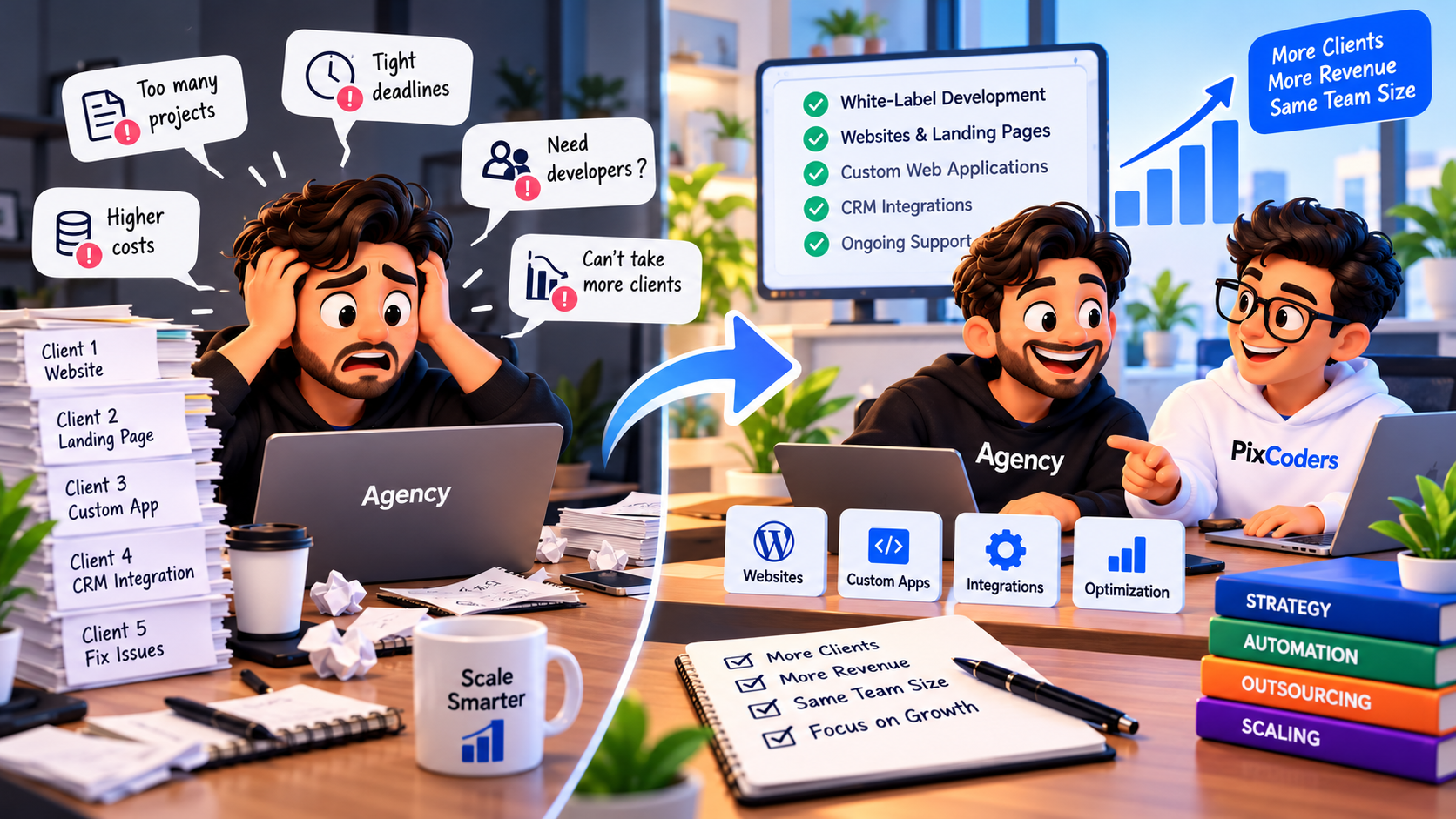
Running a marketing, creative, or web design agency means managing multiple client expectations while maintaining quality, deadlines, and profitability.
But what happens when your clients need custom websites, landing pages, CRM integrations, or web applications that your internal team cannot deliver?
Hiring full-time developers is one option. However, it introduces additional costs, recruitment challenges, and ongoing management responsibilities.
White-label web development offers another approach.
By partnering with an external development team, agencies can deliver professional websites and web applications under their own brand without expanding their internal development department.
In this guide, we explain how white-label web development works, its benefits, common challenges, and how to choose the right development partner.
What Is White-Label Web Development?
White-label web development is a service where an external developer or development team builds websites, landing pages, or web applications for an agency's clients.
The agency presents and delivers the completed work under its own brand.
The development partner works behind the scenes, while the agency maintains its relationship with the end client.
Example
Imagine a marketing agency that specializes in advertising campaigns and lead generation.
One of its clients requests a custom website with a lead capture form and CRM integration.
Instead of hiring a developer, the agency partners with a white-label development provider.
The process looks like this:
The client requests a website from the marketing agency.
The agency collects the project requirements.
The agency shares the technical brief with its development partner.
The development partner builds and tests the website.
The agency reviews the work and requests any necessary adjustments.
The agency delivers the finished website to its client under its own brand.
The agency remains responsible for the client relationship, while the development partner handles the agreed technical work.
Why Do Agencies Use White-Label Web Development?
Agencies often face challenges when clients request services outside their core expertise.
For example, a branding agency may create excellent visual identities but lack the development resources needed to build complex websites.
Similarly, a marketing agency may generate qualified leads but need technical support to develop landing pages, automate workflows, or integrate CRM systems.
White-label partnerships help agencies expand their delivery capabilities.
1. Reduce Hiring Costs
Building an internal development team requires investment in recruitment, salaries, training, and management.
White-label development allows agencies to access technical expertise on a project-by-project basis.
This can be especially useful for agencies with fluctuating workloads.
2. Offer More Services
With the right development partner, an agency can offer additional technical services, including:
Business websites
Landing pages
WordPress development
Custom web applications
CRM integrations
API integrations
SaaS MVP development
Website maintenance
This allows agencies to respond to a wider range of client requirements.
3. Focus on Core Services
Marketing agencies should be able to focus on marketing.
Creative agencies should be able to focus on branding and design.
Outsourcing technical implementation helps internal teams spend more time on strategy, client relationships, and business development.
4. Handle More Projects
An agency with limited internal development capacity may struggle when several clients request websites at the same time.
A reliable white-label partner can provide additional delivery capacity when needed.
However, project timelines and availability should always be agreed upon before work begins.
5. Maintain Brand Consistency
In a white-label arrangement, the agency can remain the primary point of contact for the client.
The development partner follows the agreed communication, confidentiality, and handoff procedures.
This helps the agency maintain a consistent client experience.
What Services Can Agencies Outsource?
White-label development is not limited to simple websites.
Depending on the technical expertise of the development partner, agencies can outsource several types of projects.
Website Development
Business websites, corporate websites, service pages, and responsive websites designed to represent a client's brand.
Landing Page Development
Conversion-focused landing pages for advertising campaigns, lead generation, product launches, and marketing funnels.
WordPress Development
Custom WordPress websites, theme customization, CMS configuration, and website maintenance.
Custom Web Applications
Applications that require functionality beyond a standard website, such as client portals, dashboards, booking systems, and internal business tools.
CRM and API Integrations
Connecting websites and applications with CRM platforms, external APIs, forms, and business workflows.
SaaS MVP Development
Building an initial version of a software product to validate an idea before investing in a larger platform.
White-Label Development vs. Hiring In-House Developers
Both approaches can work well, depending on an agency's business model.
In-House Development
An internal development team may be suitable when an agency has a predictable volume of technical projects and needs continuous collaboration.
Advantages include direct communication, internal knowledge retention, and greater control over daily development activities.
However, the agency must manage salaries, recruitment, training, and workload.
White-Label Development
A white-label partner may be a better fit when an agency needs flexible technical capacity or specialized skills for particular projects.
It can reduce the need for permanent hiring and help agencies expand their service offerings.
The tradeoff is that successful outsourcing requires clear requirements, reliable communication, and consistent quality control.
The best option depends on project volume, budget, technical complexity, and the level of control the agency needs.
How to Choose a White-Label Web Development Partner
Choosing the right partner is essential for maintaining quality and protecting client relationships.
Before starting a partnership, evaluate the following factors.
1. Technical Expertise
Review the technologies and project types the development partner supports.
For example, a project may require WordPress, Laravel, React, Next.js, or third-party API integrations.
The partner should have experience relevant to the actual requirements.
2. Portfolio and Previous Work
Ask for examples of completed projects.
Look at functionality, responsiveness, performance, usability, and the complexity of previous implementations.
3. Communication
A development partner should provide clear updates and explain technical decisions in understandable language.
Agree on communication channels, project milestones, and response expectations.
4. Confidentiality
White-label partnerships often involve access to client information, designs, credentials, and business requirements.
Establish appropriate confidentiality arrangements and define who may communicate directly with the end client.
5. Quality Assurance
Ask how the development partner tests websites before delivery.
Depending on the project, testing may include responsive layouts, browser compatibility, forms, authentication, security, accessibility, and performance.
6. Maintenance and Support
A website may require updates or bug fixes after launch.
Clarify what is included in the original project and what requires a separate maintenance agreement.
How the White-Label Development Process Works
A structured workflow helps agencies and development partners collaborate effectively.
Step 1: Project Brief
The agency provides the project requirements.
A useful brief includes:
Project objectives
Target audience
Required pages and features
Available designs
Content status
Technical integrations
Expected timeline
Budget range
Step 2: Scope and Estimate
The development partner reviews the requirements and identifies potential technical challenges.
Both parties agree on deliverables, milestones, pricing, and responsibilities.
Step 3: Development
The development partner implements the agreed functionality.
The agency receives progress updates based on the communication plan.
Step 4: Quality Assurance
The completed work is tested against the approved requirements.
Any issues discovered during testing are documented and resolved according to the agreed scope.
Step 5: Review and Delivery
The agency reviews the finished project before presenting it to the end client.
The development partner provides the agreed files, access, documentation, or deployment support.
Step 6: Ongoing Support
If required, the partnership continues through maintenance, technical improvements, or future client projects.
Common White-Label Development Mistakes to Avoid
White-label outsourcing can create problems when expectations are unclear.
Here are some common mistakes agencies should avoid.
Starting Without a Clear Scope
Unclear requirements can lead to unexpected costs, delays, and disagreements.
Document deliverables before development begins.
Choosing Based Only on Price
A low quote does not necessarily represent the best value.
Evaluate technical quality, communication, reliability, and support alongside cost.
Ignoring Ownership and Handoff
Agree on source code ownership, licensing, credentials, hosting access, and handoff responsibilities before starting.
Promising Unrealistic Deadlines
Development timelines depend on project complexity, content readiness, integrations, and revision requirements.
Confirm feasibility with the development partner before committing to a client deadline.
Skipping Quality Assurance
Even a visually attractive website can contain broken forms, security issues, or mobile usability problems.
Always review and test the project before delivery.
Can Small Marketing Agencies Benefit from White-Label Development?
Yes.
Small marketing agencies may benefit significantly from flexible development partnerships because they often operate with limited internal resources.
For example, a small agency may specialize in social media management and paid advertising but receive occasional requests for landing pages or websites.
Instead of turning down these opportunities, the agency can collaborate with a development partner.
This allows the agency to explore additional services without immediately committing to permanent development hires.
However, the agency should ensure that project pricing, delivery responsibilities, and client expectations remain commercially sustainable.
How PixCoders Supports Marketing and Creative Agencies
PixCoders provides web development support for agencies that need additional technical delivery capacity.
We work with marketing, branding, web design, and creative agencies that want to deliver websites and web applications under their own brand.
Our development services include:
Website development
Landing pages and marketing funnels
WordPress development
Laravel and Next.js development
CRM and API integrations
Custom web applications
SaaS MVP development
Our goal is to help agencies deliver reliable technical solutions while maintaining ownership of their client relationships.
We can work behind the scenes as a white-label development partner, following the agreed project scope, communication process, and handoff requirements.
Frequently Asked Questions
What does white-label web development mean?
White-label web development means an external development provider builds a website or application that an agency delivers to its client under the agency's own brand.
Can a marketing agency outsource website development?
Yes. Marketing agencies can outsource technical development while continuing to manage strategy, client communication, and project delivery.
Will the development partner contact my clients?
This depends on the agreement. In a white-label arrangement, the development partner can remain behind the scenes and communicate only with the agency.
Is white-label development suitable for small agencies?
Yes. It can be useful for smaller agencies that need technical expertise without hiring a full-time development team.
What should I prepare before outsourcing a project?
Prepare a clear brief describing the project's objectives, features, designs, integrations, timeline, and expected deliverables.
Can agencies outsource custom web applications?
Yes. Agencies can outsource custom applications, dashboards, CRM integrations, and other technical projects when their development partner has the necessary expertise.
Conclusion
White-label web development gives marketing, branding, and creative agencies a practical way to expand their technical capabilities.
Instead of building every website or application internally, agencies can collaborate with development partners who handle the technical implementation.
A successful partnership depends on clear requirements, reliable communication, quality assurance, and well-defined responsibilities.
Looking for a white-label web development partner?
PixCoders helps agencies build websites, landing pages, web applications, and integrations under their own brand.
Share your project brief with PixCoders to discuss the requirements and receive an estimate.