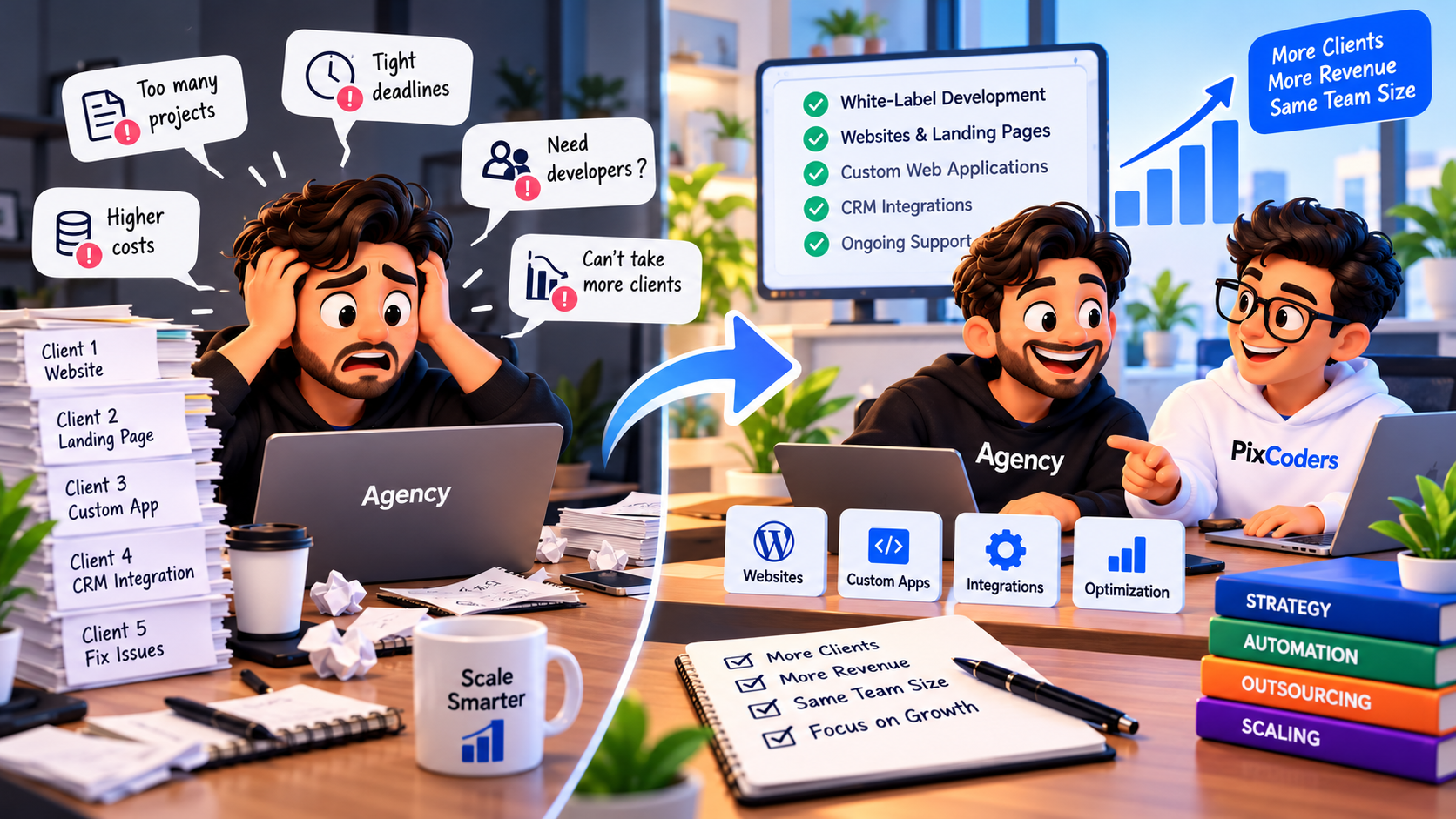
Growing a digital agency sounds exciting.
More clients. More projects. More revenue.
But there's a problem many agency owners eventually face.
More clients usually mean more work, more pressure, and more employees.
Your marketing team is already managing campaigns, optimizing websites, generating leads, and communicating with clients.
Meanwhile, new clients are requesting WordPress websites, custom web applications, landing pages, CRM integrations, and technical improvements.
Hiring additional developers might seem like the obvious solution.
But what if you could grow your agency without expanding your development team?
The answer is to build a more scalable business model.
In this guide, you'll discover how to scale a digital agency without hiring more developers, improve operational efficiency, and increase your capacity through outsourcing, automation, and white-label development partnerships.
What Does Scaling a Digital Agency Actually Mean?
Scaling an agency isn't simply about getting more clients.
It's about increasing revenue without increasing operating costs at the same rate.
For example, imagine your agency generates $10,000 per month.
Your team handles marketing, client communication, and website development.
As your client base grows, your monthly revenue reaches $20,000.
But to support that growth, you hire additional developers, project managers, and support staff.
Your revenue doubles, but your expenses also increase significantly.
This is growth, but it isn't necessarily efficient scaling.
A scalable agency can serve more clients while keeping its fixed operating costs under control.
This requires better processes, automation, strategic outsourcing, and a clear focus on profitable services.
Why Hiring More Developers Isn't Always the Best Solution
Hiring developers can be the right decision for agencies with consistent development workloads.
However, it isn't always the most efficient approach for small and medium-sized digital agencies.
1. Higher Fixed Expenses
Full-time developers require salaries, equipment, software, onboarding, and management.
These expenses continue even when your agency has fewer development projects.
2. Unpredictable Project Demand
One month, your agency might receive five website projects.
The following month, you might receive only one.
Maintaining a large development team during quieter periods can reduce profitability.
3. Recruitment Takes Time
Finding experienced developers with the right technical skills can take weeks or months.
Meanwhile, your agency may lose opportunities because it lacks development capacity.
4. Different Projects Require Different Technologies
One client needs WordPress.
Another requires a Laravel application.
A third needs React, Next.js, or a custom CRM integration.
Hiring full-time specialists for every technology isn't always realistic.
5. More Employees Require More Management
Expanding your development department also increases communication, supervision, and coordination responsibilities.
Instead of focusing on business development, agency owners may spend more time managing technical operations.
The solution isn't necessarily to avoid hiring. It's to make sure your agency uses the right resources at the right time.
7 Proven Strategies to Scale Your Digital Agency Without Hiring More Developers
Let's explore seven practical strategies agencies can use to grow while maintaining operational flexibility.
1. Partner With a White-Label Web Development Provider
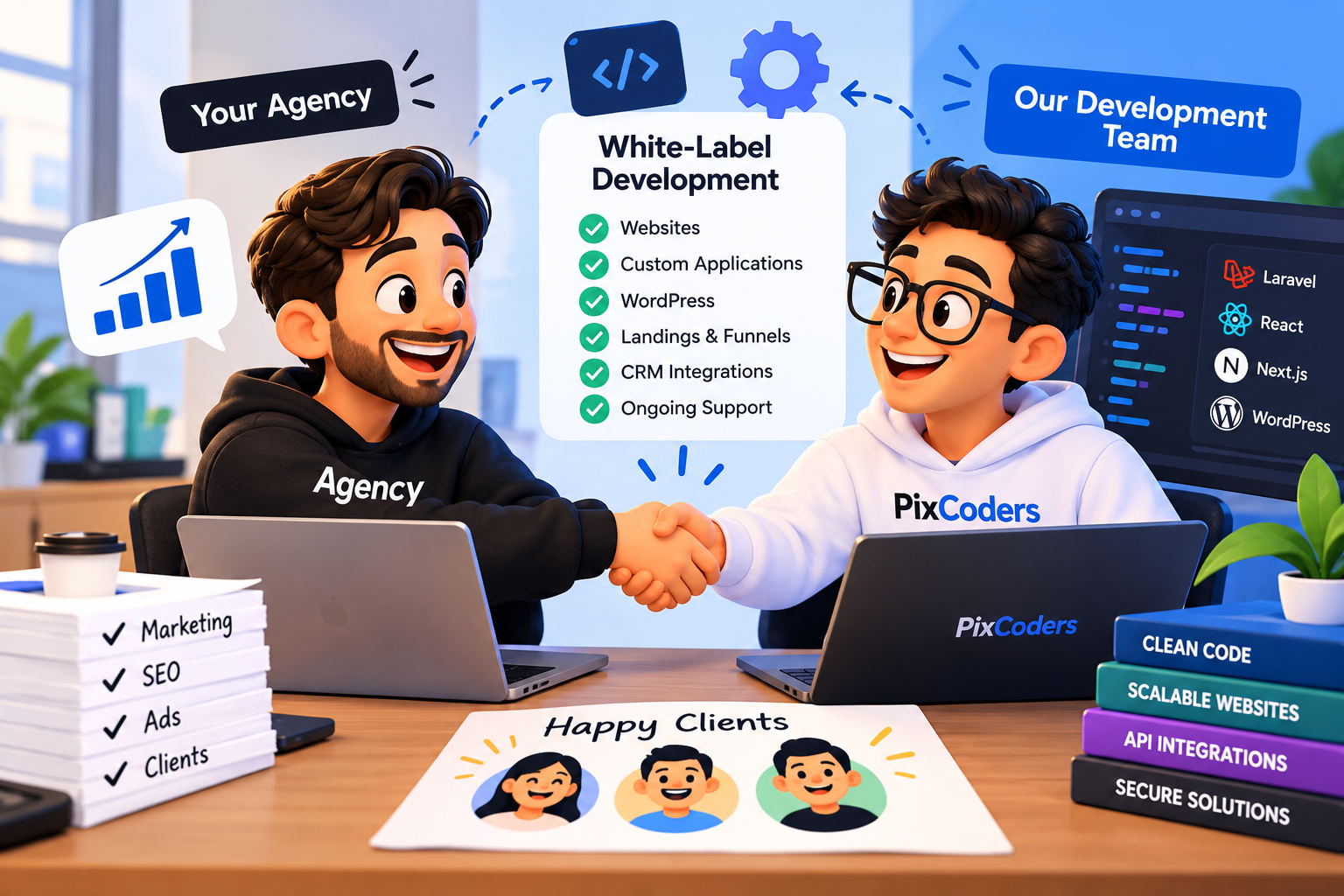
One of the most effective ways to increase development capacity is through a white-label web development partnership.
A white-label development partner builds websites and applications on behalf of your agency.
Your agency manages the client relationship, defines the requirements, and delivers the completed project under its own brand.
The development partner handles the technical implementation.
Example: Scaling With White-Label Development
Imagine your marketing agency receives five new projects:
Client A needs a WordPress website.
Client B needs a custom booking system.
Client C needs a landing page.
Client D needs a CRM integration.
Client E needs a custom web application.
Instead of recruiting developers for every project, your agency collaborates with a technical partner.
The partner handles development while your team focuses on marketing strategy, client communication, and business growth.
Benefits of White-Label Development
Flexible capacity: Accept projects according to your agency's workload and your partner's availability.
Lower fixed costs: Pay for agreed projects or development capacity rather than maintaining unnecessary permanent positions.
Broader service offerings: Provide websites, applications, and integrations without building an internal department for every specialty.
Brand consistency: Deliver projects under your agency's identity through an agreed white-label arrangement.
More business opportunities: Accept suitable technical projects that your agency might otherwise decline.
For digital agencies that primarily specialize in marketing, this model can provide a practical path toward expansion.
2. Focus on High-Margin Services
Not every service contributes equally to your agency's profitability.
Some projects generate revenue but require significant time, revisions, and ongoing management.
To scale effectively, identify the services that produce the best return on your team's time.
Examples include:
SEO retainers
Paid advertising management
Conversion rate optimization
Marketing automation
Lead generation services
Website maintenance agreements
Recurring technical support
Calculate Your Actual Profitability
Suppose your agency sells a website project for $3,000.
Your development partner charges $1,500.
Additional project management and delivery expenses total $300.
Your remaining contribution before general overhead and taxes is:
$3,000 - $1,500 - $300 = $1,200
That's a 40% project contribution margin.
This is an illustrative example, not a guaranteed industry margin.
Track the profitability of different services to understand which projects deserve more attention.
The objective is not simply to generate more sales.
It's to generate more profitable sales.
3. Standardize Your Project Delivery Process
Scaling becomes difficult when every project follows a completely different process.
Without standardization, teams waste time repeating the same tasks.
A structured workflow improves consistency and makes outsourcing easier.
Create a Repeatable Project Workflow
Step 1: Client Discovery
Understand the client's objectives, requirements, budget, and expectations.
Step 2: Project Scope
Document the functionality, deliverables, integrations, revisions, and deadlines.
Step 3: Technical Estimation
Request an estimate from your internal team or development partner.
Step 4: Project Approval
Confirm the scope, timeline, and payment terms.
Step 5: Development
Assign the implementation to the appropriate technical resources.
Step 6: Quality Assurance
Test the website or application before delivery.
Step 7: Launch and Support
Deploy the project and provide agreed post-launch support.
Use Project Templates
Create reusable templates for common services:
WordPress business websites
Landing page development
E-commerce websites
Custom application development
CRM integrations
Website maintenance
Templates help reduce administrative work and improve project consistency.
4. Automate Repetitive Agency Tasks
Automation is another important component of agency scaling.
Your team shouldn't spend hours manually completing tasks that software can handle reliably.
Tasks You Can Automate
Lead Management
Automatically capture leads from website forms and organize them in your CRM.
Client Onboarding
Use structured forms to collect project requirements and required files.
Project Notifications
Send automatic updates when tasks change status or reach important milestones.
Reporting
Generate recurring reports using appropriate analytics and reporting tools.
Follow-Up Reminders
Create reminders for leads that require additional contact.
Internal Workflows
Connect different platforms using APIs or automation services.
Why Automation Matters
Automation helps reduce manual effort and repetitive administrative work.
However, every automated process should be tested and monitored.
Poorly designed automation can create errors instead of improving efficiency.
Start with the workflows that consume the most time and have clear, repeatable steps.
5. Build Recurring Revenue Streams
Many digital agencies depend heavily on one-time projects.
This creates unpredictable revenue.
A more scalable business model combines project-based work with recurring services.
Examples of Recurring Agency Services
Website Maintenance
Provide website updates, technical troubleshooting, security maintenance, and ongoing support.
SEO Management
Offer technical SEO improvements, content optimization, and performance monitoring.
Paid Advertising
Manage ongoing advertising campaigns and campaign optimization.
Marketing Automation
Maintain integrations, workflows, and customer management processes.
Technical Support
Provide monthly development support and agreed website improvements.
Example of Recurring Revenue
Imagine your agency has:
10 maintenance clients paying $150 per month.
5 SEO clients paying $500 per month.
5 advertising management clients paying $600 per month.
That creates:
$7,000 in monthly recurring revenue.
This is an illustrative revenue scenario before operating expenses.
Recurring services can improve predictability, but agencies must still account for delivery costs, client retention, and support requirements.
6. Improve Client Retention Before Increasing Acquisition
Acquiring more clients is important.
But retaining existing clients can also support sustainable growth.
When clients trust your agency, they may request additional services.
For example, a client initially hires your agency for Google Ads management.
Later, they need:
A new landing page
Website performance improvements
CRM integration
A custom reporting dashboard
Technical SEO implementation
Instead of referring the client elsewhere, your agency can deliver additional technical services through a white-label partner.
How to Improve Client Retention
Communicate regularly.
Set realistic expectations.
Deliver work according to agreed requirements.
Respond professionally to technical issues.
Identify opportunities to improve client results.
Offer relevant additional services rather than unnecessary upsells.
Long-term client relationships make agency growth more sustainable.
7. Create a Reliable Network of Technical Partners
Depending on a single individual for every technical requirement can create operational risks.
As your agency grows, build relationships with dependable specialists and development partners.
Your network might include expertise in:
WordPress development
Laravel backend development
React and Next.js
API integrations
CRM systems
Database architecture
Website performance
Technical SEO
Web application maintenance
A reliable partner network allows your agency to select appropriate expertise for each project.
However, avoid creating unnecessary coordination complexity.
Choose partners with clear communication, proven capabilities, and documented agreements.
In-House Developers vs. White-Label Development: Which Scales Better?
Both models have advantages.
The right approach depends on your agency's workload, financial resources, and business strategy.
In-House Development
An internal development team may offer:
Direct access to developers
Consistent internal workflows
Greater control over technical processes
Long-term technical knowledge
However, it also requires ongoing staffing and management expenses.
White-Label Development
A white-label partnership may offer:
Flexible project-based collaboration
Broader technical capabilities
Reduced fixed staffing commitments
Confidential project delivery
Additional development capacity
However, success depends on the partner's reliability, availability, and communication.
The Hybrid Model
Many agencies can benefit from combining both approaches.
For example, your agency might maintain a small internal team for essential technical tasks while outsourcing larger or specialized projects.
This provides internal control while allowing additional flexibility.
The goal is to build a development model that supports your agency's actual demand.
How to Scale From 5 to 20 Clients Without Expanding Your Development Team
Let's explore a hypothetical example.
Imagine your agency currently serves five clients.
Your team consists of:
One agency owner
One marketing specialist
One designer
You provide SEO, digital advertising, and website services.
Stage 1: Build a Repeatable Process
Document your onboarding, communication, and delivery procedures.
Create templates for proposals, quotations, and project requirements.
Stage 2: Establish a Development Partnership
Find a white-label development provider that can handle the types of technical projects your clients frequently request.
Agree on pricing, scope management, quality requirements, and communication.
Stage 3: Automate Administrative Tasks
Introduce a CRM and project management workflows.
Reduce unnecessary manual data entry and repetitive communication.
Stage 4: Expand Your Service Portfolio
Begin offering additional services such as:
WordPress development
Custom landing pages
CRM integrations
Technical SEO
Custom web applications
Stage 5: Increase Client Acquisition
Once your delivery process is reliable, invest in appropriate acquisition channels.
These might include:
LinkedIn outreach
SEO and content marketing
Strategic partnerships
Client referrals
Paid advertising
Direct business outreach
Stage 6: Monitor Your Agency's Capacity
Track important indicators:
Monthly revenue
Gross profit margin
Client retention
Project delivery time
Revision frequency
Client satisfaction
Partner availability
As client volume grows, adjust your processes and partnerships accordingly.
Reaching 20 clients without additional developers is possible in some agency models, but it is not guaranteed. It depends on project complexity, service scope, existing capacity, and partner performance.
Common Mistakes That Prevent Digital Agencies From Scaling
Even agencies with strong marketing capabilities can struggle to grow.
Here are common problems to avoid.
Accepting Every Project
Not every opportunity is profitable or suitable for your team.
Evaluate technical requirements and delivery capacity before committing.
Underpricing Development Services
Some agencies underestimate development costs, revisions, testing, and project management.
This can reduce profitability even when revenue increases.
Working Without Clear Specifications
Poorly defined requirements often result in scope changes, delivery delays, and unnecessary revisions.
Choosing Partners Based Only on Price
The lowest quotation doesn't necessarily provide the best value.
Evaluate technical quality, reliability, communication, and support.
Neglecting Quality Assurance
Every website or application should be reviewed before deployment.
Technical issues can affect client satisfaction and your agency's reputation.
Scaling Before Building Reliable Processes
Increasing sales without sufficient delivery capacity can lead to missed deadlines and declining service quality.
Build systems that support growth before aggressively increasing your workload.
How PixCoders Helps Digital Agencies Scale
At PixCoders, we help digital agencies expand their technical capabilities without building large in-house development teams.
Our white-label development approach allows marketing agencies, creative studios, and digital consultants to outsource technical implementation while maintaining control of their client relationships.
Our Development Services
White-Label Website Development
Professional business websites developed according to your agency's requirements.
WordPress Development
Custom WordPress websites, customization, optimization, and maintenance.
Custom Web Applications
Business dashboards, management systems, customer portals, and specialized web platforms.
Laravel Development
Backend application development, APIs, database-driven systems, and custom business functionality.
React and Next.js Development
Modern frontend development for interactive websites and web applications.
CRM and API Integrations
Connecting websites, lead management systems, and business applications.
Technical SEO and Website Performance
Technical improvements supporting search engine accessibility, performance, and usability.
Ongoing Development Support
Maintenance, troubleshooting, updates, and technical improvements.
Why Work With PixCoders?
Our development services are designed to support agency collaboration.
We focus on:
White-label development arrangements
Confidential project collaboration
Project-based technical outsourcing
Custom development solutions
Clear project requirements
Long-term technical partnerships
Your agency manages the marketing strategy, client relationships, and business growth.
PixCoders supports the technical development work.
Your Agency. Your Clients. Your Brand.
You don't necessarily need to hire more developers to offer additional technical services.
With a dependable development partner, you can increase project capacity while maintaining your agency's identity.
Explore our development services at https://pixcoders.dev
Frequently Asked Questions
How can I scale my digital agency without hiring employees?
You can increase operational capacity by standardizing processes, automating repetitive tasks, improving profitability, and outsourcing suitable work to reliable partners.
Can a digital agency grow without an in-house development team?
Yes.
Some agencies focus entirely on marketing, branding, or client management while outsourcing technical implementation.
The model requires reliable partners and clear project management processes.
What is white-label web development?
White-label web development allows an agency to outsource website or application development to another provider and deliver the project under the agency's brand.
Is outsourcing web development profitable for agencies?
It can be profitable when the agency prices projects appropriately and manages development costs, revisions, and overhead.
Profitability depends on the specific project and partnership arrangements.
Should I hire developers or outsource development?
If your agency has consistent development demand and sufficient financial resources, hiring may be appropriate.
If demand fluctuates or requires multiple technical specialties, outsourcing can offer greater flexibility.
What services should a digital agency outsource?
Common options include WordPress development, landing pages, custom web applications, CRM integrations, API development, and technical maintenance.
How do I choose a white-label development partner?
Evaluate technical expertise, portfolio quality, communication, confidentiality arrangements, delivery processes, and post-launch support.
Starting with a smaller project can help assess the partnership.
Can white-label development help marketing agencies offer more services?
Yes.
Marketing agencies can use white-label partnerships to offer technical services such as website development, custom applications, and CRM integrations without creating a complete internal development department.
Conclusion: Scale Smarter, Not Just Bigger
Scaling a successful digital agency requires more than acquiring new clients.
It requires operational efficiency, reliable delivery processes, and a business model that can support additional demand.
Hiring developers may eventually be necessary, but it isn't the only path to growth.
By combining automation, standardized workflows, recurring services, and strategic white-label partnerships, agencies can expand their capabilities while controlling fixed operating expenses.
The most important decision is finding a sustainable balance between client acquisition and project delivery.
Ready to Grow Your Digital Agency?
PixCoders helps marketing agencies and digital studios deliver websites, custom web applications, and technical integrations without building an in-house development team.
Focus on growing your agency.
Let PixCoders handle the development.
Visit https://pixcoders.dev to explore a technical partnership.