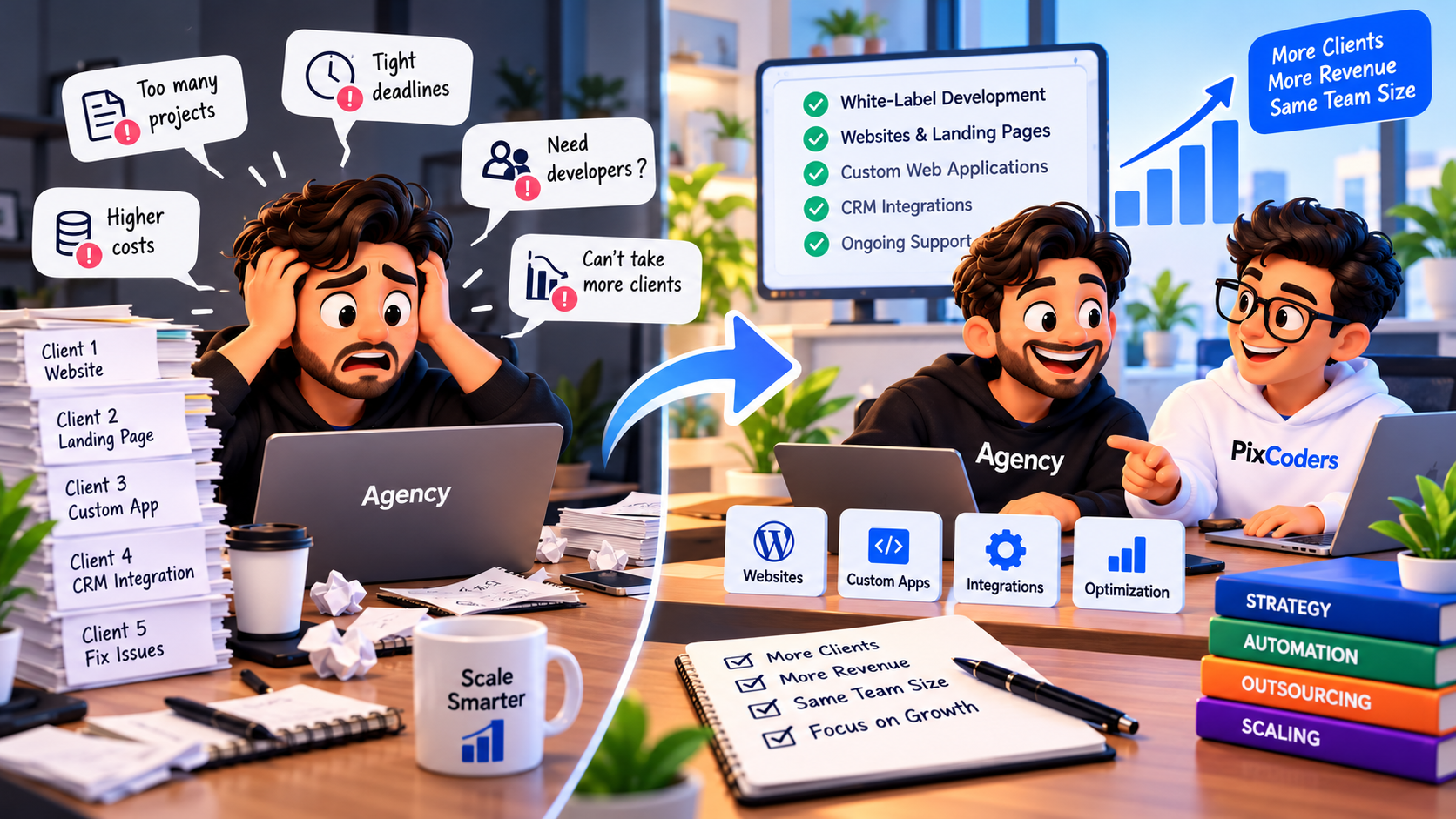
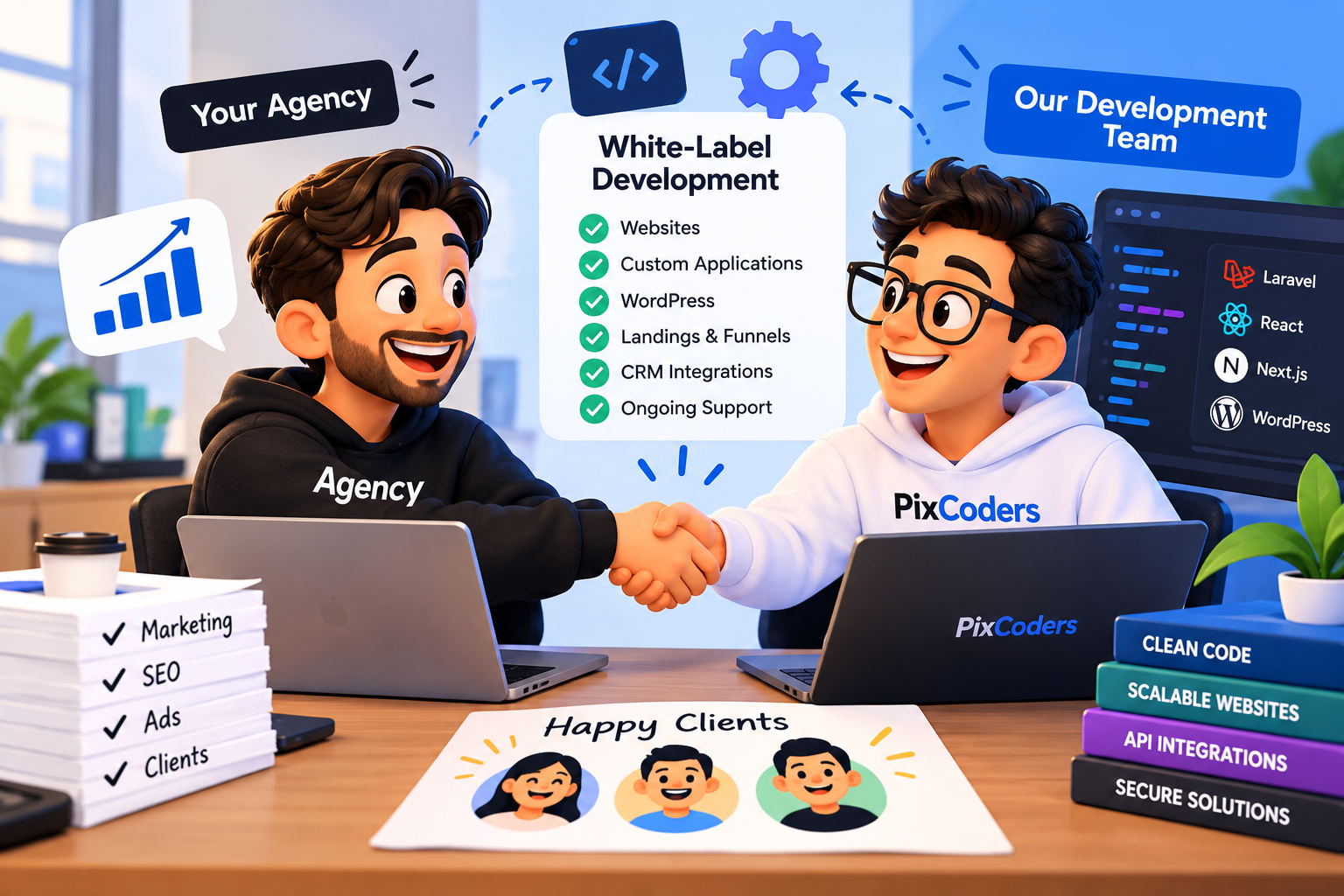
Running a digital agency comes with an important challenge: clients expect more services, faster delivery, and increasingly sophisticated technical solutions.
Your agency might specialize in digital marketing, SEO, branding, or paid advertising. But what happens when a client requests a custom website, an advanced WordPress platform, or a CRM integration?
Hiring an in-house development team is not always practical, especially for small and growing agencies.
That's where white-label web development services become valuable.
By partnering with a reliable white-label development provider, digital agencies can deliver professional websites, custom applications, and technical solutions without expanding their internal teams.
In this guide, we'll explore the best white-label development services, how they work, what they cost, and how to choose the right technical partner for your agency.
What Are White-Label Web Development Services?
White-label web development is a business model where a specialized development partner builds websites or applications on behalf of another company.
The digital agency manages the client relationship, while the development partner handles the technical implementation.
The completed project is delivered under the agency's brand.
For example, imagine your marketing agency signs a client who needs a custom WordPress website.
Instead of hiring a developer, your agency partners with a white-label web development provider.
The development partner builds the website according to your specifications, and your agency delivers the finished product to the client.
Your agency maintains control of the relationship, pricing, communication, and branding.
The result: Your agency can offer professional web development services without maintaining a full-time development team.
Why Digital Agencies Need White-Label Development Partners
Modern marketing agencies are expected to deliver much more than advertising campaigns.
Clients increasingly need websites, landing pages, marketing automation, integrations, and custom business applications.
Without technical resources, agencies may struggle to accept these opportunities.
Here are the main reasons digital agencies invest in white-label development partnerships.
1. Expand Your Services Without Hiring Developers
Recruiting experienced developers requires time, money, and ongoing management.
White-label partnerships allow agencies to access technical expertise whenever projects require it.
Instead of building an internal development department, your agency can offer:
Professional business websites
Custom WordPress development
E-commerce solutions
Landing pages and sales funnels
Custom web applications
CRM integrations
API integrations
Website maintenance and technical support
This approach makes expanding your agency's service portfolio more manageable.
2. Reduce Fixed Operating Costs
An in-house development team involves salaries, onboarding, software, equipment, and ongoing management expenses.
Outsourcing technical projects converts some of those fixed expenses into project-based costs.
Agencies can allocate development budgets according to their actual workload.
This is especially useful for smaller digital agencies with fluctuating project volumes.
3. Accept More Client Projects
Imagine receiving three development requests in the same week.
Your agency has the clients, but your internal team is already busy.
Without additional resources, you might need to delay projects or decline opportunities.
A dependable white-label development partner provides additional technical capacity.
Your agency can focus on project management, marketing strategy, and client relationships while development work continues.
4. Focus on Your Agency's Core Expertise
Marketing agencies generate the most value when they focus on what they do best.
For many agencies, that means:
Digital marketing strategy
Search engine optimization
Paid advertising campaigns
Conversion optimization
Branding and creative services
Client acquisition and account management
Outsourcing development allows your team to concentrate on these activities instead of managing every technical implementation.
5. Build Long-Term Client Relationships
Clients often prefer working with one agency that understands their business.
When your agency can provide both marketing and technical services, clients have fewer reasons to search for additional suppliers.
For example, an agency managing Google Ads can also offer landing page development, website improvements, and lead management integrations.
This creates opportunities for additional projects and ongoing services.
7 Best White-Label Web Development Services for Digital Agencies
Not every agency requires the same technical solutions.
The best white-label service depends on your clients, existing capabilities, and business model.
Below are seven valuable services that digital agencies can offer through a development partner.
1. White-Label WordPress Development
WordPress remains a practical solution for business websites, blogs, landing pages, and content-driven platforms.
Marketing agencies frequently receive WordPress development requests because clients want websites they can update independently.
A white-label WordPress development service can include:
Custom WordPress website development
Theme development and customization
WooCommerce stores
Website redesigns
Performance optimization
Technical SEO implementation
Plugin customization
Website migrations
Ongoing maintenance
Best for: SEO agencies, branding studios, local marketing agencies, and companies serving small and medium-sized businesses.
Example:
A branding agency creates a visual identity for a restaurant chain.
The client also needs a professional website.
The agency provides the design specifications, while its white-label development partner builds the WordPress website.
The branding agency delivers both services under its own brand.
2. Custom Web Application Development
Some clients need more than a traditional website.
They may require a business dashboard, booking platform, customer portal, or internal management system.
Custom web application development allows agencies to accept these projects without hiring a dedicated software engineering team.
Common solutions include:
Customer management dashboards
Online booking systems
Business management applications
Customer portals
Internal workflow tools
SaaS platforms
Reporting dashboards
Custom administration panels
Depending on project requirements, development technologies may include Laravel, React, Next.js, and relational databases.
Best for: Digital agencies working with growing businesses that require specialized functionality.
Example:
A marketing agency serves a car rental company.
The client wants a system to manage reservations, vehicles, and customers.
Rather than declining the project, the agency partners with a custom web development provider to deliver the application.
This creates an additional revenue opportunity for the agency.
3. White-Label Landing Page Development
Landing pages are essential for agencies managing paid advertising campaigns.
A successful advertising campaign requires more than traffic.
Visitors must arrive at a relevant, fast, and easy-to-use page.
White-label landing page development helps agencies create conversion-focused experiences without managing the coding process.
Services may include:
Google Ads landing pages
Meta Ads landing pages
Lead generation funnels
Product launch pages
Campaign-specific landing pages
Form integrations
Analytics implementation
Conversion tracking
A/B testing implementation
Best for: PPC agencies, performance marketing teams, and lead generation companies.
Example:
A paid advertising agency manages campaigns for a dental clinic.
The agency needs a landing page where potential patients can request appointments.
A development partner builds the page, integrates the lead form, and implements the required tracking.
The marketing agency can then focus on campaign optimization and lead generation.
4. CRM and API Integration Services
Marketing agencies increasingly work with multiple platforms.
A typical client might use advertising platforms, website forms, spreadsheets, email systems, and CRM software.
Without proper integration, information becomes fragmented.
White-label CRM and API integration services can help connect these systems.
Common projects include:
Website form-to-CRM integration
Lead management integrations
Google Sheets automation
Custom API connections
Customer data synchronization
Lead assignment workflows
Email notification systems
CRM dashboard development
Best for: Lead generation agencies, automation consultants, and performance marketing businesses.
Example:
An agency generates leads through multiple landing pages.
The client wants every lead to appear automatically in a central dashboard.
A white-label development partner can implement the required integration, reducing manual data entry and helping the client organize follow-ups.
5. White-Label E-Commerce Development
Online stores require more than an attractive design.
Businesses need secure checkout processes, manageable product catalogs, reliable performance, and integration with payment and delivery systems.
Digital agencies can expand into e-commerce through white-label development partnerships.
Services can include:
WooCommerce development
Custom e-commerce functionality
Product catalog implementation
Payment gateway integration
Shipping integrations
Customer account systems
Store performance optimization
E-commerce maintenance
Best for: Creative agencies, branding studios, and digital marketing companies serving retail businesses.
6. Website Maintenance and Technical Support
Website development does not end when a project launches.
Businesses need regular maintenance to keep their websites functioning correctly.
Agencies can offer recurring technical support through a white-label partner.
Common maintenance services include:
Website updates
Security patching
Backup monitoring
Performance checks
Bug fixes
Plugin compatibility checks
Technical troubleshooting
Minor feature improvements
Maintenance agreements can create recurring revenue opportunities while helping agencies maintain long-term client relationships.
Best for: Agencies that manage multiple client websites.
7. Technical SEO and Website Performance Optimization
A visually attractive website is not necessarily optimized for search engines or user experience.
Technical implementation can affect crawling, indexing, mobile usability, and website performance.
White-label technical SEO services may include:
Website structure improvements
XML sitemap configuration
Robots.txt configuration
Canonical tag implementation
Structured data integration
Core Web Vitals improvements
Mobile usability fixes
Redirect implementation
Indexing issue resolution
These services complement an agency's existing SEO strategy.
Best for: SEO agencies, content marketing teams, and digital marketing consultants.
White-Label Development vs. In-House Developers vs. Freelancers
Choosing the right development model depends on workload, budget, and project complexity.
Here is a practical comparison.
In-House Development Team
Advantages:
Direct control over development workflows
Consistent availability
Deeper internal knowledge of company processes
Considerations:
Ongoing salary expenses
Recruitment and onboarding requirements
Management responsibilities
Fixed capacity and staffing commitments
Independent Freelancers
Advantages:
Flexible project-based hiring
Access to specialized skills
Useful for limited technical tasks
Considerations:
Availability may vary
Project management remains your responsibility
Quality and documentation can differ
Larger projects may require multiple specialists
White-Label Development Partner
Advantages:
Flexible technical capacity
Project-based collaboration
Potential access to multiple technologies
Branded delivery arrangements
Opportunity for long-term technical support
Considerations:
Requires clear communication and processes
Quality depends on the selected partner
Confidentiality and ownership must be documented
Delivery expectations require coordination
Which option is best?
An in-house team may be appropriate for agencies with predictable, continuous development needs.
Freelancers can work well for isolated tasks.
A white-label development partner is often an effective choice for agencies that want broader technical capabilities without immediately building an internal development department.
How Much Do White-Label Web Development Services Cost?
White-label development pricing varies according to project scope, technical complexity, integrations, design requirements, and ongoing support.
There is no universal price that applies to every provider.
Most partnerships use one of the following pricing models.
Fixed-Price Projects
The development partner provides a quote for a clearly defined project.
This model works well for:
Business websites
Landing pages
WordPress development
Website redesigns
Projects with stable requirements
Your agency can calculate its selling price based on development costs, project management, revisions, and desired profit margin.
Hourly Development
The partner charges for actual development time.
This approach can be useful for:
Ongoing improvements
Bug fixes
Technical support
Projects with evolving requirements
Monthly Development Retainers
Agencies with consistent workloads may agree on monthly development capacity.
This can provide more predictable access to technical resources.
Custom Project Estimates
Complex platforms, SaaS applications, and business management systems generally require individual estimates.
Before comparing prices, agencies should confirm what the quote includes.
Important questions include:
Are revisions included?
Who handles deployment?
Is testing included?
Who owns the source code?
Is post-launch support available?
Are integrations included in the estimate?
What happens if requirements change?
The cheapest quotation is not always the most economical option.
A reliable partner with clear specifications, quality assurance, and transparent delivery processes may reduce expensive rework later.
How to Choose the Best White-Label Web Development Partner
Selecting a technical partner is an important business decision.
Your agency's reputation depends on the quality of the work delivered to clients.
Before starting a partnership, evaluate the following factors.
1. Technical Expertise
Choose a provider with experience in the technologies your clients actually need.
For example, if your agency regularly delivers WordPress websites, confirm that the partner understands WordPress development, performance, and maintenance.
For custom applications, evaluate experience with backend frameworks, frontend development, databases, authentication, and API integrations.
2. Portfolio and Previous Work
Review completed projects.
Look for relevant examples demonstrating:
Responsive design
Functional features
Technical complexity
Usability
Consistent implementation quality
A portfolio is more useful when it includes projects similar to your clients' requirements.
3. Confidentiality and White-Label Agreements
A genuine white-label partnership should establish clear boundaries.
Your agency should understand who can communicate with the client, use project materials, and publicly reference completed work.
Consider documenting:
Confidentiality obligations
Client communication rules
Intellectual property ownership
Source code ownership
Portfolio usage permissions
Data protection responsibilities
An NDA may be appropriate depending on the project and contractual requirements.
4. Communication and Project Management
Even skilled developers can create problems when communication is inconsistent.
Choose a partner that provides:
Clear project requirements
Realistic delivery estimates
Regular progress updates
Transparent issue reporting
Defined revision procedures
These practices help agencies manage client expectations.
5. Testing and Quality Assurance
Before launching a project, confirm how the partner checks the final deliverables.
Testing should match the project's scope and may include:
Responsive layout testing
Functional testing
Cross-browser checks
Form validation
Accessibility checks
Performance testing
Security reviews
A structured testing process reduces the likelihood of avoidable launch issues.
6. Post-Launch Support
Websites and applications sometimes require fixes after deployment.
Ask whether the partner provides:
Bug-fix support
Maintenance agreements
Technical documentation
Deployment assistance
Ongoing development services
7. Start With a Small Project
Before outsourcing a large client application, consider starting with a smaller development task.
A trial project helps evaluate code quality, communication, reliability, and delivery.
This is often a practical way to reduce partnership risk.
How a White-Label Development Partnership Works
A successful partnership should follow a clear process.
Step 1: Your Agency Receives a Client Request
Your agency identifies the client's requirements, objectives, and budget.
Step 2: Share the Technical Requirements
You provide the development partner with relevant specifications, designs, and functionality requirements.
Step 3: Receive an Estimate
The development partner reviews the scope and provides a proposed timeline and quotation.
Step 4: Development Begins
After approval, the partner implements the technical solution while your agency manages the client relationship.
Step 5: Review and Testing
Your agency reviews the deliverables and requests any necessary corrections within the agreed scope.
Step 6: Project Delivery
The completed website or application is deployed and delivered according to the agreed white-label arrangement.
Step 7: Ongoing Support
When required, the partner continues providing maintenance, technical support, and future improvements.
This process gives the agency a structured way to expand its delivery capabilities.
Why Agencies Work With PixCoders
At PixCoders, we help digital agencies, marketing companies, and creative studios deliver web development projects without building an in-house technical team.
Our focus is straightforward: provide dependable technical implementation while allowing agencies to maintain control of their brand and client relationships.
We collaborate with agencies that need additional development capacity for websites, custom platforms, and business integrations.
Our White-Label Development Services
WordPress Development
Professional WordPress websites, customization, maintenance, and technical improvements.
Custom Website Development
Responsive websites developed according to specific business and design requirements.
Custom Web Applications
Web-based business systems, dashboards, customer portals, and specialized applications.
Laravel and React Development
Custom application development using modern frontend and backend technologies.
CRM and API Integrations
Connecting websites, lead management systems, and business platforms.
Technical SEO and Performance
Technical implementation to improve website structure, search accessibility, and performance.
Maintenance and Technical Support
Ongoing development assistance, troubleshooting, and website improvements.
Built for Digital Agency Collaboration
Our approach is designed for agencies that want to expand their service offerings without losing control of client relationships.
Depending on the agreement, collaboration can include:
Confidential development
White-label project delivery
Project-based outsourcing
Custom technical implementation
Ongoing development support
Clear communication and project coordination
Whether your agency needs a WordPress website or a custom business application, PixCoders can support the technical side of delivery.
Explore our services and portfolio at https://pixcoders.dev.
Frequently Asked Questions About White-Label Web Development
What is a white-label web development service?
A white-label web development service allows an agency to outsource website or application development to a technical partner and deliver the completed project under the agency's own brand.
The agency typically maintains the client relationship while the partner handles development.
Is white-label web development suitable for small agencies?
Yes.
Small agencies can use white-label partnerships to offer additional services without immediately hiring full-time developers.
The model is particularly useful when development demand varies between projects.
Can marketing agencies outsource WordPress development?
Yes.
Marketing agencies frequently outsource WordPress development, including business websites, landing pages, WooCommerce stores, custom themes, and maintenance.
Can white-label developers build custom web applications?
Yes, provided the partner has the appropriate technical expertise.
Projects may include CRM systems, customer portals, business dashboards, booking platforms, and custom SaaS applications.
Will the development partner contact my clients?
That depends on the collaboration agreement.
In a confidential white-label arrangement, client communication can remain entirely under the agency's control.
Communication rules should be established before development begins.
Who owns the website source code?
Ownership depends on the contract.
Agencies should confirm source code ownership, intellectual property rights, repository access, and handover requirements before starting a project.
Is white-label development cheaper than hiring an in-house team?
It can reduce fixed staffing expenses, especially when an agency has irregular development requirements.
However, total cost depends on project volume, management overhead, technical complexity, and the selected provider.
How do I find reliable white-label web development services?
Review the provider's technical expertise, portfolio, communication processes, confidentiality arrangements, and post-launch support.
Starting with a small paid project can help determine whether the partnership is suitable.
Final Thoughts
The best white-label web development services help digital agencies expand their technical capabilities while maintaining control of their brand, projects, and client relationships.
Whether your agency needs WordPress development, landing pages, custom applications, CRM integrations, or technical support, selecting the right partner can make project delivery more flexible.
The key is finding a development provider that understands your requirements, communicates clearly, and delivers reliable technical solutions.
Looking for a White-Label Web Development Partner?
PixCoders helps digital agencies turn client requirements into functional websites and custom web applications.
Expand your agency's technical capabilities without building an in-house development team.
Visit https://pixcoders.dev to explore our services and discuss your next project.