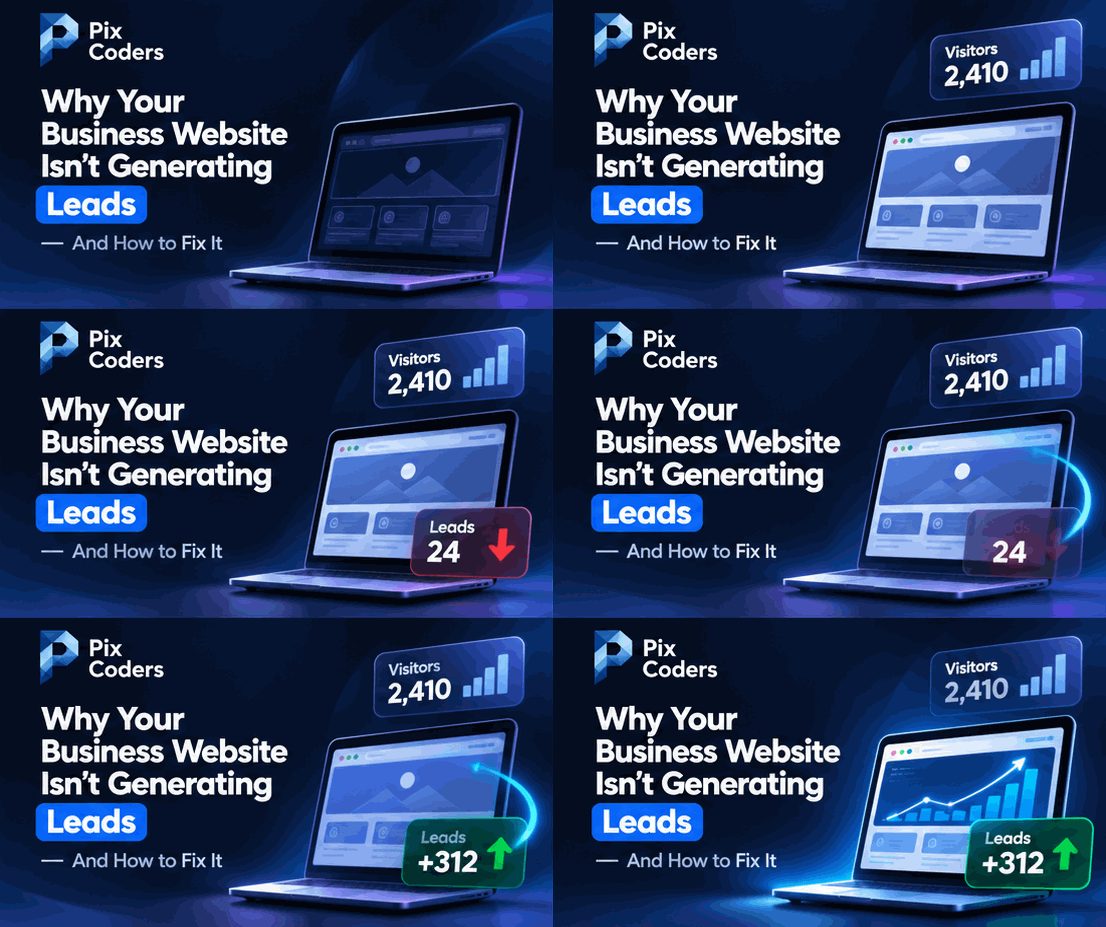
A professional website should do more than make your business look good online. It should attract potential customers, establish credibility, generate qualified leads, and create new business opportunities.
However, many businesses invest in website development without achieving meaningful results. Their websites receive visitors but generate few inquiries, appointments, or sales.
The problem is not always a lack of traffic. In many cases, the website itself is not designed around customer acquisition.
Whether you operate a healthcare clinic, real estate company, marketing agency, car rental business, hotel, e-commerce store, or professional services company, your website should be one of your most valuable digital assets.
In this guide, we explore why business websites fail to generate leads and how professional web development, SEO, automation, and better user experiences can turn a website into a measurable business growth channel.
1. Your Website Does Not Communicate Your Value Clearly
When potential customers visit your website, they should immediately understand:
What your business offers.
Who your services are designed for.
Why they should choose your company.
How they can contact you or purchase your services.
A confusing homepage creates unnecessary friction and increases the likelihood that visitors will leave without taking action.
Instead of using generic statements such as "We provide innovative solutions," businesses should communicate specific benefits that address customer needs.
A successful website combines clear messaging, professional design, relevant content, and well-positioned calls to action.
The objective is not simply to impress visitors. It is to help them make informed decisions.
2. Your Website Is Too Slow
Website performance directly affects the customer experience.
Slow-loading pages can frustrate potential customers, particularly those browsing from mobile devices or slower internet connections.
Common performance problems include:
Unoptimized images and videos.
Excessive third-party scripts.
Poor hosting configurations.
Unnecessary plugins.
Inefficient website architecture.
Missing caching and optimization strategies.
A professionally optimized website should prioritize loading speed, responsiveness, stability, and accessibility.
At PixCoders, we approach performance as part of the overall development process rather than treating it as an optional improvement after launch.
A faster website creates a smoother browsing experience and removes unnecessary barriers between visitors and your business.
3. Your Website Is Not Optimized for Mobile Devices
Potential customers may discover your business through Google, social media, online advertising, or messaging applications while using their smartphones.
If your website is difficult to navigate on mobile devices, you could be losing valuable business opportunities.
A mobile-friendly website should include:
Responsive page layouts.
Easy-to-read typography.
Accessible navigation.
Simple contact forms.
Clearly visible contact buttons.
Optimized images.
Smooth booking and purchasing experiences.
For businesses that rely on WhatsApp communication, appointments, reservations, or online sales, mobile usability is particularly important.
Professional responsive web development ensures that your customers receive a consistent experience across smartphones, tablets, and desktop computers.
4. Potential Customers Cannot Find Your Business on Google
Even a professionally designed website cannot generate organic leads if potential customers cannot discover it.
Search Engine Optimization (SEO) helps search engines understand your website, its services, and its relevance to customer searches.
An effective SEO strategy includes:
Proper website structure.
Keyword research based on customer intent.
Optimized page titles and descriptions.
Relevant service pages.
Internal linking.
Technical SEO.
Structured data.
Local SEO.
Helpful and original content.
Website performance optimization.
For example, a car rental company in Dubai should have dedicated pages addressing its rental services and relevant locations. A healthcare clinic should provide clear information about its treatments, specialists, and appointment process.
Similarly, a marketing agency should clearly explain its services, expertise, and target industries.
The goal of SEO is not simply to attract more visitors. It is to attract people who are actively searching for what your business provides.
5. Your Business Is Not Prepared for AI-Powered Search
Customers increasingly discover businesses through AI-powered search experiences and conversational assistants.
Traditional SEO remains important, but businesses should also consider how their information is interpreted by AI systems.
Generative Engine Optimization (GEO) and Answer Engine Optimization (AEO) focus on making business information clearer, more structured, and easier to understand.
Businesses can improve their readiness for AI-powered discovery by:
Publishing detailed service descriptions.
Answering frequently asked customer questions.
Creating useful educational content.
Maintaining accurate business information.
Implementing appropriate structured data.
Publishing authentic case studies.
Demonstrating relevant experience and expertise.
These practices can support both traditional search visibility and AI-powered discovery, although inclusion in AI-generated answers is never guaranteed.
At PixCoders, we help businesses build websites with clear content structures and technical foundations that support modern search experiences.
6. Your Website Does Not Have Effective Calls to Action
Every important page on your website should guide visitors toward a meaningful next step.
A call to action, commonly known as a CTA, encourages visitors to interact with your business.
Effective examples include:
Request a Free Quote.
Book an Appointment.
Schedule a Consultation.
Request a Demonstration.
Contact Us on WhatsApp.
Get a Customized Proposal.
Check Availability.
Different businesses require different conversion strategies.
A hotel website may prioritize direct reservations, while a software company may focus on product demonstrations. A healthcare clinic may encourage appointment bookings, while a marketing agency may collect project inquiries.
Your calls to action should reflect your customers' needs and the primary objectives of your business.
7. Your Website Lacks Credibility and Trust
Before contacting a company, potential customers often evaluate whether the business appears reliable and professional.
A website without customer reviews, previous projects, company information, or clear contact details may create uncertainty.
To establish credibility, businesses should include:
Authentic customer testimonials.
Detailed portfolio projects.
Case studies.
Company and team information.
Professional contact information.
Transparent service descriptions.
Relevant certifications, when applicable.
Privacy policies and appropriate security measures.
Trust is particularly important for businesses offering high-value services, healthcare solutions, custom software, or financial transactions.
A professional website should demonstrate what your company can deliver rather than relying exclusively on marketing promises.
8. Your Website Is Not Connected to Your Business Operations
Generating an inquiry is only the beginning of the customer acquisition process.
Many businesses lose potential customers because inquiries are handled manually, responses are delayed, or customer information is spread across multiple platforms.
Connecting your website to a Customer Relationship Management (CRM) system can help centralize and organize incoming leads.
A connected business website can support:
Automatic lead collection.
Customer information management.
Sales pipeline tracking.
Appointment management.
Email notifications.
Customer follow-up workflows.
Lead assignment.
Business reporting.
For example, when a potential customer submits a contact form, their information can automatically be recorded in a CRM, assigned to a team member, and included in a follow-up workflow.
This reduces manual work and creates a more organized customer acquisition process.
PixCoders develops custom web applications, CRM integrations, and connected business systems tailored to specific operational requirements.
9. You Are Not Measuring Website Performance
Without reliable data, it is difficult to understand whether your website contributes to business growth.
Businesses should monitor meaningful metrics such as:
Website traffic.
Organic search impressions.
Contact form submissions.
WhatsApp button clicks.
Appointment bookings.
Qualified leads.
Conversion rates.
Customer acquisition costs.
Revenue generated through the website.
Tools such as Google Analytics and Google Search Console can help businesses understand how visitors discover and interact with their websites.
However, collecting data is not enough. Businesses must use this information to identify problems, improve customer experiences, and refine their digital strategies.
A website should be continuously evaluated against real business objectives.
10. Your Website Has Outgrown Its Original Purpose
Many businesses launch a simple website when they first establish their company.
As the business grows, its digital requirements change.
A basic informational website may eventually need:
Online booking functionality.
Customer dashboards.
Multilingual content.
E-commerce capabilities.
Online payments.
CRM integrations.
Automated business workflows.
Custom reporting systems.
Advanced administration tools.
Rather than relying on disconnected tools and temporary solutions, businesses can invest in a digital platform designed around their actual operations.
Custom web development allows companies to build solutions that reflect their business processes, customer expectations, and long-term objectives.
How Different Industries Can Generate More Leads Online
Every industry has different customer acquisition requirements.
Healthcare and Medical Clinics
Medical websites should help patients understand available treatments, discover specialists, establish trust, and schedule appointments easily.
Hotels and Hospitality Businesses
Hospitality websites can support direct booking opportunities, multilingual experiences, room presentations, and integration with existing reservation systems.
Car Rental Companies
Car rental websites should make it easy for customers to explore vehicles, understand rental requirements, check availability, and submit reservation requests.
Real Estate Companies
Real estate platforms can provide searchable property listings, advanced filtering, inquiry forms, and CRM integrations to manage potential buyers and tenants.
Marketing and Creative Agencies
Agencies can expand their service offerings through reliable white-label development partnerships without immediately increasing their internal development capacity.
Startups and Growing Businesses
Startups can benefit from custom digital platforms, scalable web applications, MVP development, and automated workflows that support business growth.
The right solution depends on the business model, target customers, and operational requirements.
How PixCoders Helps Businesses Grow Online
PixCoders is a web development and digital solutions partner helping businesses, startups, and marketing agencies build professional websites and connected digital systems.
Our approach focuses on combining technical development with practical business objectives.
Our services include:
Professional Website Development
Modern, responsive websites designed to communicate your services, establish credibility, and encourage customer inquiries.
Custom Web Applications
Business platforms, dashboards, and digital systems developed around your specific operational requirements.
CRM Development and Integrations
Connected systems that help businesses organize customer information, manage leads, and improve internal workflows.
E-commerce and Booking Solutions
Online stores and reservation platforms designed to simplify customer transactions and service bookings.
SEO and AI Search Optimization
Website structures and content improvements designed to support visibility across traditional and emerging search experiences.
White-Label Development for Agencies
Flexible technical development support for marketing and creative agencies that want to deliver professional digital projects under their own brand.
From initial project planning to development, testing, deployment, and agreed handover, we focus on delivering solutions that support meaningful business objectives.
Frequently Asked Questions
Why is my website getting traffic but no leads?
Common reasons include unclear messaging, poor mobile usability, weak calls to action, irrelevant traffic, insufficient credibility, and complicated contact processes. Analyzing visitor behavior can help identify the underlying problems.
How much does a professional business website cost?
Website development costs depend on the number of pages, design requirements, functionality, integrations, content, and project complexity. A customized project estimate provides a more accurate cost than a generic price.
Can I improve my existing website without rebuilding it?
Yes. Many websites can benefit from performance improvements, SEO updates, redesigned landing pages, better contact forms, and improved content without requiring a complete rebuild.
How long does SEO take to generate results?
SEO is a long-term strategy. Results may develop over several months depending on competition, website quality, existing visibility, and the consistency of optimization efforts.
Can a website automatically collect and manage leads?
Yes. Websites can be connected to CRM systems, notification services, and automation workflows to collect inquiries, organize customer information, and support follow-up processes.
Does PixCoders work with international businesses?
Yes. PixCoders supports remote collaboration with businesses, startups, and marketing agencies that require professional web development and digital solutions.
Does PixCoders provide white-label development?
Yes. PixCoders can work behind your agency's brand, allowing your agency to maintain ownership of the client relationship while receiving technical development support.
Conclusion: Turn Your Website Into a Business Growth Asset
Your website should be more than an online business card.
It should help potential customers discover your company, understand your services, trust your expertise, and take action.
By combining professional website development, search optimization, effective user experiences, CRM integrations, and continuous improvement, businesses can create digital platforms that support sustainable growth.
Whether you need a new business website, improvements to an existing platform, a custom software solution, or a reliable development partner for your agency, PixCoders can help you identify and build the right solution.
Ready to build a website that works for your business?
Contact PixCoders today to discuss your requirements, explore potential solutions, and request a free project quote.
Build better. Get discovered. Create more opportunities.
PixCoders - Your Web Development and Digital Solutions Partner.
Website: https://pixcoders.dev
Email: contact@pixcoders.dev