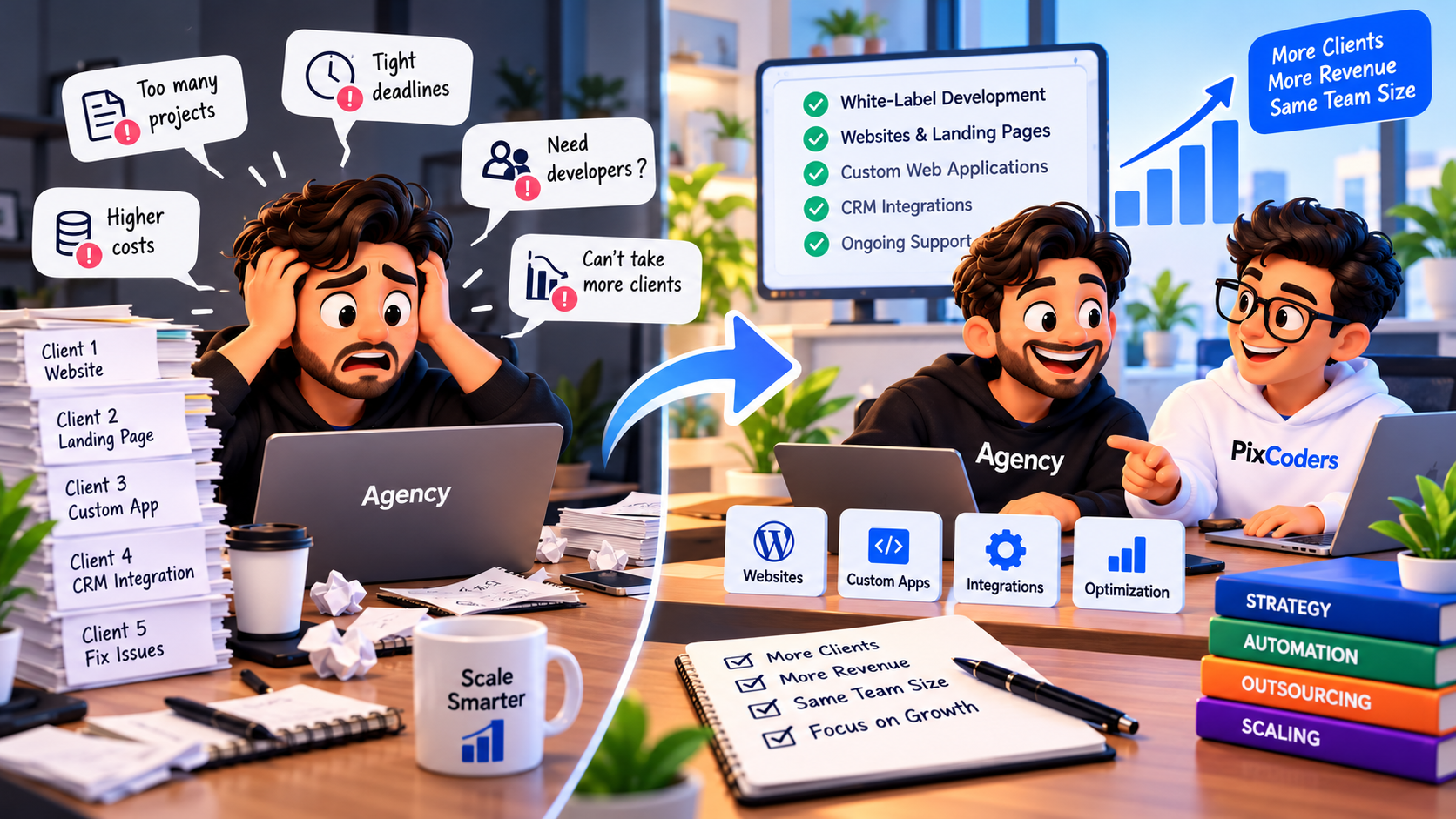

For marketing agencies, creative studios, and digital agencies, outsourcing web development can be a practical way to expand services without hiring an entire technical team.
However, one important question often comes up:
How much does white-label web development cost?
The answer depends on several factors, including project complexity, required technologies, custom functionality, delivery timelines, and ongoing support.
A simple landing page may require only a few days of development, while a custom web application with authentication, dashboards, and API integrations can require significantly more planning and implementation.
Understanding white-label development pricing helps agencies estimate projects accurately, protect their profit margins, and deliver better value to clients.
In this guide, we'll explore the main pricing models, factors that influence development costs, common pricing mistakes, and how agencies can build profitable outsourcing partnerships.
1. What Is White-Label Web Development?
White-label web development is a collaboration model where an external developer or development provider builds websites or applications on behalf of an agency.
The agency manages the end-client relationship and delivers the completed project under its own brand.
For example, imagine a digital marketing agency that specializes in advertising campaigns.
A client requests a professional business website with a contact form, analytics tracking, and CRM integration.
Instead of hiring an internal development team, the agency partners with a white-label developer.
The development provider handles the agreed technical work, while the agency remains responsible for communication, strategy, and client management.
This allows agencies to offer additional services while maintaining their existing business model.
2. How Does White-Label Web Development Pricing Work?
White-label development pricing generally follows three common models.
Fixed-Price Projects
In a fixed-price model, the agency and development partner agree on a total project price before development begins.
This approach works best when project requirements are clearly defined.
Examples include:
Business websites
Landing pages
Portfolio websites
Small e-commerce stores
WordPress development
Well-defined application features
Advantages:
Predictable development costs
Easier client quotations
Clear payment milestones
Easier profitability calculations
Limitations:
Changes outside the original scope may require additional fees or revised timelines.
Fixed-price development is usually most effective when both parties agree on the deliverables, revision process, and acceptance criteria.
Hourly Development
Under an hourly model, agencies pay for the actual development time spent on the project.
This model can be useful for:
Website maintenance
Technical troubleshooting
Feature improvements
API integrations
Legacy code modifications
Projects with evolving requirements
Hourly pricing offers flexibility, but total costs can be harder to predict.
Agencies should agree on estimated hours, approval thresholds, reporting, and budget limits before work begins.
Monthly Development Retainers
A monthly retainer provides access to development capacity through a recurring arrangement.
For example, an agency may reserve a defined number of development hours each month for ongoing client projects.
This approach can work well for agencies handling multiple websites, campaigns, and technical requests.
Potential benefits include:
More predictable monthly spending
Easier development planning
Consistent collaboration
Better understanding of agency workflows
Additional technical capacity without permanent recruitment
Monthly retainers are particularly useful when an agency has recurring development needs.
However, the agreement should clearly define included hours, availability, response expectations, and how unused capacity is handled.
3. What Factors Affect White-Label Development Costs?
Two websites that look similar can have very different development costs.
The visual design represents only one part of the implementation.
Several technical and business factors determine the final project price.
Project Complexity
A five-page business website generally requires less technical work than a custom platform with multiple user roles and integrations.
More complex functionality requires additional planning, development, and testing.
Design Requirements
Development costs depend partly on whether the agency provides complete, developer-ready designs.
Building a website from approved Figma files may require a different scope than providing both UI/UX design and development.
Technology Stack
The selected technology influences implementation requirements.
Common technologies include:
WordPress for content-driven websites.
Laravel for custom backend applications.
React and Next.js for interactive web interfaces.
MySQL or PostgreSQL for application data.
REST APIs for system integrations.
The most appropriate technology depends on the project's business and technical requirements.
Custom Features
Features such as authentication, payment processing, booking systems, client dashboards, and workflow automation introduce additional development requirements.
Third-Party Integrations
Connecting a website with a CRM, payment gateway, email service, or external platform may require API development, authentication, error handling, and testing.
Delivery Timeline
Urgent deadlines may require additional planning or resources.
Agencies should confirm technical feasibility before promising delivery dates to clients.
Quality Assurance
Professional development includes testing, bug fixing, responsive checks, and integration validation.
These activities should be accounted for in project estimates.
Maintenance and Support
Ongoing updates, monitoring, security maintenance, and technical support may be billed separately from initial development.
4. How Much Does White-Label Web Development Cost?
There is no universal price for white-label web development.
The final cost depends on the provider, project requirements, service scope, and commercial agreement.
To illustrate how a development partner may structure pricing, consider the published starting prices from PixCoders.
Example: PixCoders Development Pricing
Development Service | Published Starting Price |
|---|---|
Landing Page | 1,500 MAD |
Portfolio Starter | 2,500 MAD |
Business Website Pro | 5,500 MAD |
E-commerce Starter | 7,500 MAD |
CRM Starter | 8,000 MAD |
Custom System Starter | 12,000 MAD |
SaaS MVP | 18,000 MAD |
These are PixCoders' published starting estimates, not industry-wide average prices or guaranteed quotations.
Final prices depend on the agreed functionality, design requirements, integrations, and delivery scope.
For current packages and inclusions, visit:
https://pixcoders.dev/en/pricing
5. How Agencies Can Price White-Label Projects Profitably
One of the biggest advantages of white-label development is the ability to combine outsourced technical delivery with an agency's own services.
However, agencies should calculate their total costs before establishing client prices.
Example: Business Website Project
Imagine an agency receives a request for a professional business website.
The hypothetical project budget looks like this:
Cost Component | Amount |
|---|---|
Outsourced development | $800 |
Design and project management | $200 |
Testing and launch coordination | $100 |
Total agency cost | $1,100 |
Client selling price | $1,600 |
Gross project profit | $500 |
In this example, the project generates a gross margin of:
Gross Margin = (Selling Price − Direct Costs) ÷ Selling Price × 100
($1,600 − $1,100) ÷ $1,600 × 100 = 31.25%
These figures are illustrative, not market pricing recommendations.
Actual profitability will also depend on overhead, taxes, payment processing fees, additional revisions, and other business expenses.
Markup vs. Profit Margin
Agencies should understand the difference between markup and profit margin.
Markup measures profit relative to cost.
Profit margin measures profit relative to the selling price.
If a project costs $1,000 and sells for $1,500:
Markup: 50%
Gross margin: approximately 33.3%
Confusing these calculations can lead to inaccurate pricing decisions.
Don't Forget Your Agency's Value
The development cost is only one part of the service.
Your agency may also provide:
Business strategy
UI/UX design
Content development
SEO strategy
Client communication
Project management
Quality assurance
Analytics and conversion tracking
Ongoing consultation
Your client pricing should account for the complete value and costs of the services you deliver.
6. Hidden Costs Agencies Should Consider
When evaluating a white-label development quotation, always verify what is included.
Common costs that may fall outside the initial development price include:
Hosting and Domain Registration
Servers, domains, hosting subscriptions, and infrastructure costs may be billed separately.
Premium Plugins and Software Licenses
Certain WordPress plugins, themes, APIs, and commercial services require additional licenses.
Content Creation
Copywriting, product descriptions, translation, and image preparation may not be included in development packages.
Additional Revisions
Requests beyond the agreed scope can increase project costs.
Third-Party Service Fees
Payment gateways, email platforms, APIs, and other services may charge usage or subscription fees.
Ongoing Maintenance
Updates, security monitoring, backups, and improvements may require a separate maintenance agreement.
Technical SEO and Performance Improvements
Some basic technical SEO work may be included, but extensive optimization or SEO strategy can require additional services.
Best Practice: Request a written quotation listing included services, excluded services, third-party costs, and post-launch responsibilities.
7. Fixed-Price Projects vs. Monthly Retainers: Which Is Better?
Both models can be useful, depending on an agency's workload.
Factor | Fixed-Price Project | Monthly Retainer |
|---|---|---|
Best for | Defined projects | Recurring development |
Budget | Per-project | Recurring monthly |
Flexibility | Scope-dependent | Within agreed capacity |
Planning | Project milestones | Continuous task planning |
Ideal agency | Occasional outsourcing | Regular development demand |
Choose Fixed-Price Development When:
The project has clear requirements.
Development is needed occasionally.
A defined deliverable is required.
The agency wants predictable project costs.
Choose a Monthly Retainer When:
Multiple clients require regular updates.
Your agency frequently launches landing pages.
Technical support is needed every month.
You need consistent access to development capacity.
Some agencies use both models, outsourcing larger projects at fixed prices while maintaining a monthly arrangement for smaller technical tasks.
8. How to Reduce White-Label Development Costs Without Sacrificing Quality
Reducing project costs should not mean eliminating essential testing or selecting the cheapest available developer.
Instead, agencies can improve project efficiency through better planning.
Prepare Clear Requirements
Provide a complete brief containing:
Project objectives
Required pages
Functional requirements
Design references
Content availability
Integrations
Budget expectations
Target delivery date
A clear brief helps developers identify the actual scope and produce more reliable estimates.
Finalize Designs Before Development
Frequent design changes during implementation can increase costs and delay delivery.
Whenever possible, approve important layouts and functionality before development begins.
Prioritize Essential Features
For complex applications, consider launching an MVP containing the features required to validate the product.
Additional functionality can be developed in later phases.
Reuse Appropriate Components
Existing design systems, proven components, and established development patterns can reduce unnecessary implementation work.
However, reuse should never compromise security, licensing, or project requirements.
Build Long-Term Partnerships
Working with a consistent development partner can reduce onboarding effort and improve communication.
Over time, a partner may become familiar with your preferred technologies, quality standards, and project workflows.
9. How to Choose a White-Label Development Partner Based on Value
Cost matters, but agencies should evaluate the overall quality of the partnership.
Before choosing a provider, consider:
Technical Experience
Does the provider have relevant experience with your projects and technologies?
Portfolio Quality
Can the provider demonstrate completed work similar to your client requirements?
Communication
Are requirements, updates, risks, and timelines communicated clearly?
Confidentiality
Can the provider work under your agency's brand according to an agreed arrangement?
Quality Assurance
Does the provider follow a reliable testing process?
Pricing Transparency
Are deliverables, payment terms, revisions, and exclusions documented?
Maintenance
Can the provider support the project after launch?
Project Ownership
Are source-code rights, licenses, access credentials, and handover requirements clearly defined?
Choosing a reliable development partner can help agencies avoid avoidable revisions, technical problems, and unexpected expenses.
10. Why Agencies Choose PixCoders for White-Label Development
At PixCoders, we help marketing agencies, branding studios, and digital agencies deliver professional websites and custom applications under their own brand.
Our goal is to provide flexible technical development support while agencies maintain control of their client relationships.
Our Development Services
Website Development
Responsive business websites, WordPress development, and custom website implementations.
Landing Pages and Marketing Funnels
Campaign landing pages, lead capture forms, and conversion-focused web experiences.
Custom Web Applications
Laravel and Next.js applications, administrative dashboards, customer portals, and business management tools.
CRM and API Integrations
Connecting forms, applications, lead management systems, and third-party services.
SaaS MVP Development
Building initial software products with essential functionality, user management, and integrations.
Flexible Collaboration Options
Depending on project requirements, agencies can explore:
Fixed-price development projects.
Monthly development arrangements.
Custom application development.
Ongoing technical maintenance.
We confirm project requirements, deliverables, pricing, and timelines before beginning work.
Our white-label approach allows agencies to remain the primary point of contact for their clients while we handle the agreed development tasks.
Explore our white-label services:
https://pixcoders.dev/en/services/white-label-web-development
View our pricing:
https://pixcoders.dev/en/pricing
11. Frequently Asked Questions
How much does white-label web development cost?
Costs depend on project complexity, functionality, design requirements, integrations, deadlines, and the development partner's pricing model. Request a detailed quotation based on your project requirements.
Is white-label development cheaper than hiring developers?
It can reduce the need for permanent recruitment and fixed staffing costs, particularly when an agency has occasional development needs. However, outsourcing is not automatically cheaper in every situation.
Can agencies add a markup to white-label development costs?
Yes. Agencies commonly establish their own client pricing based on outsourced development costs, project management, design, support, and the value of their complete services.
What is the best pricing model for a marketing agency?
Fixed-price projects can work well for defined deliverables, while monthly retainers may be more suitable for agencies with regular technical workloads.
Does white-label development include hosting and maintenance?
Not necessarily. Hosting, maintenance, premium licenses, and technical support depend on the specific provider and agreement.
Can I outsource custom Laravel or Next.js development?
Yes. Agencies can outsource custom application development to providers with relevant experience in these technologies.
Can small agencies use white-label development?
Yes. White-label development can help smaller agencies offer additional services without maintaining a full-time internal development team.
How can I get an accurate development quote?
Prepare a detailed brief describing the project objectives, designs, required features, integrations, timeline, and expected deliverables.
Conclusion: Understand Your Costs Before Outsourcing
White-label web development can help agencies expand their services, manage development workloads, and deliver more complete solutions to clients.
However, profitable outsourcing requires careful planning.
Agencies should understand development costs, evaluate pricing models, define project requirements, and account for ongoing maintenance and potential additional expenses.
The best development partnership is not necessarily the cheapest one.
It is the partnership that provides an appropriate balance of technical expertise, communication, quality, reliability, and commercial value.
Looking for a White-Label Development Partner?
PixCoders supports marketing agencies, creative studios, and digital agencies with websites, landing pages, custom applications, and integrations.
Whether you need development for a single client project or recurring technical support, we can review your requirements and discuss an appropriate solution.
Share your project brief, required features, and expected timeline to receive a tailored estimate.
Website: https://pixcoders.dev
Pricing: https://pixcoders.dev/en/pricing
Contact: https://pixcoders.dev/en/contact