
Laravel is known for its clean syntax and powerful features, but to truly master it, you need to understand how Laravel handles a request behind the scenes. This process is known as the Laravel Lifecycle.
In this article, we’ll walk through the lifecycle in a simple and practical way.
What Is the Laravel Lifecycle?
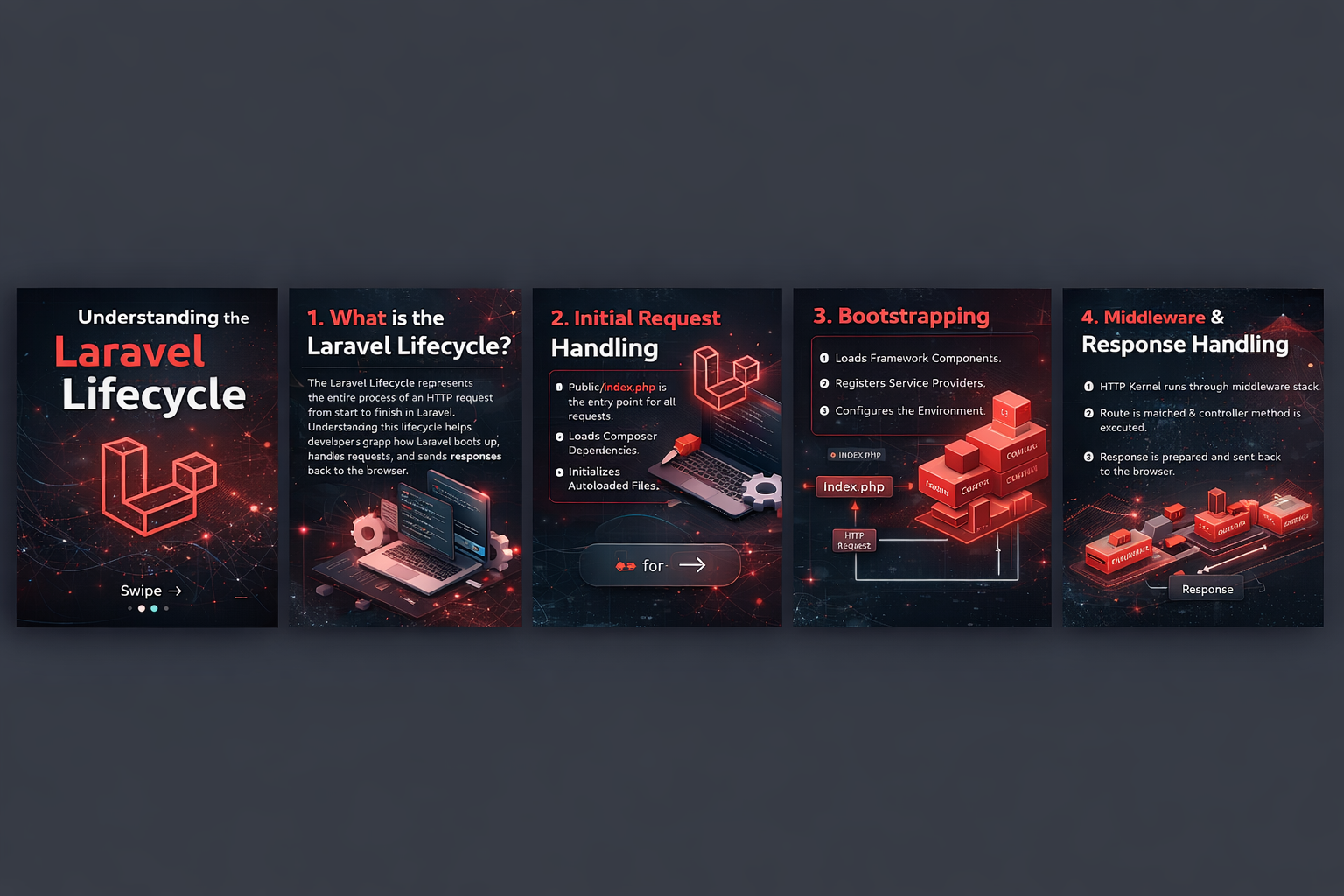
The Laravel lifecycle represents the journey of an HTTP request from the moment it enters the application until a response is returned to the browser.
Understanding this flow helps developers:
Debug issues faster
Write cleaner and more predictable code
Better understand Laravel’s core architecture
1. Entry Point (index.php)
Every request starts at public/index.php.
This file is responsible for:
Loading Composer dependencies
Bootstrapping the Laravel application
2. Bootstrapping the Application
Laravel prepares the application by:
Loading configuration files
Registering service providers
Setting up the environment
This is where Laravel’s core services become available.
3. Handling the Request
The HTTP Kernel takes control and:
Sends the request through the middleware stack
Applies authentication, validation, and other checks
4. Routing and Controllers
Laravel matches the request to a route and executes the corresponding controller or closure.
This is where your application logic runs.
5. Response Handling
After the controller finishes:
A response is generated
Middleware can modify it
The final response is sent back to the browser
Why This Matters
Understanding the Laravel lifecycle allows you to:
Build more maintainable applications
Optimize performance
Gain confidence when working with advanced Laravel features
Final Thoughts
You don’t need to memorize every internal detail, but having a clear mental model of the Laravel lifecycle will make you a stronger Laravel developer.
If you’re serious about backend development, this knowledge is essential.