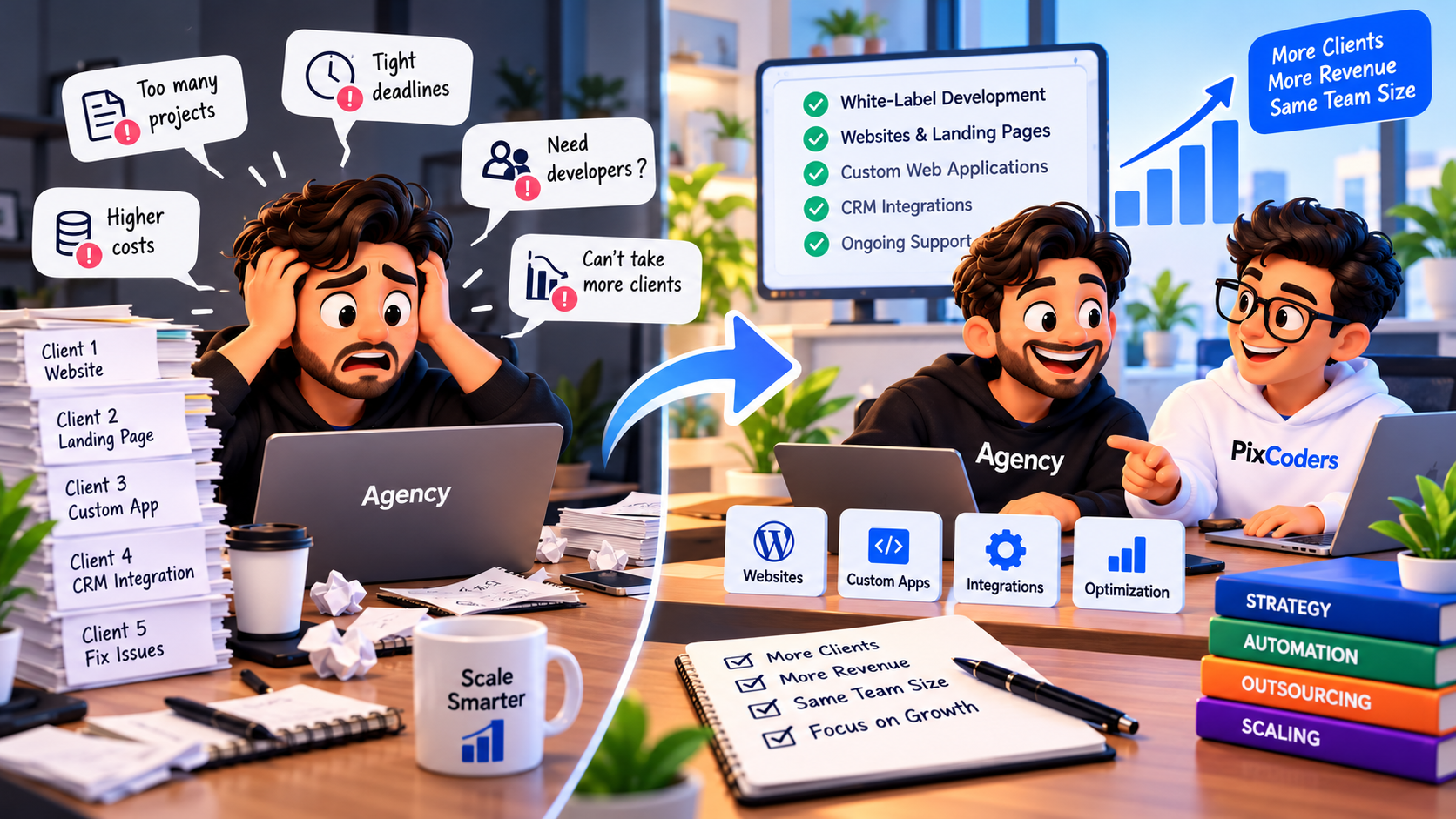

As marketing agencies and digital businesses grow, their clients often begin requesting more advanced technical services.
A client might need a professional WordPress website, a custom landing page, a CRM integration, or a complete web application.
At this point, agency owners face an important decision:
Should you hire an in-house developer or partner with an external white-label development provider?
Both approaches can help agencies deliver technical projects, but they differ significantly in cost structures, flexibility, management responsibilities, and scalability.
Hiring an internal developer provides direct access to technical expertise, while a white-label development partner offers external development capacity without requiring a permanent employee.
Neither option is universally better.
The right choice depends on your agency's workload, budget, project complexity, and long-term business goals.
In this guide, we'll compare both models and explain how to choose the most suitable development strategy for your agency.
1. What Is an In-House Developer?
An in-house developer is a software professional employed directly by your agency.
The developer works as part of your internal team and handles technical tasks according to your business requirements.
Depending on their experience and specialization, an in-house developer may work on:
Business websites
WordPress development
Landing pages
Custom web applications
Website maintenance
CRM integrations
API development
Technical troubleshooting
Internal tools and dashboards
The developer generally works within your agency's communication processes, project management systems, and technical environment.
Example
Imagine a digital marketing agency that regularly creates landing pages for advertising campaigns.
If the agency receives a consistent volume of landing page requests every month, employing a dedicated developer may help streamline development and ongoing updates.
However, maintaining an internal developer also involves recurring costs and management responsibilities.
2. What Is a White-Label Development Partner?
A white-label development partner is an external developer or development provider that builds websites, applications, or integrations on behalf of an agency.
The agency maintains the client relationship and delivers the completed project under its own brand.
The development partner handles the agreed technical implementation.
Example
Consider a branding agency that specializes in logo design, visual identity, and creative strategy.
One of its clients requests a custom website with an administrative dashboard.
Instead of recruiting a full-time developer for a single project, the agency works with a white-label development partner.
The agency provides the project requirements and manages client communication.
The partner develops the website, performs the agreed testing, and delivers the technical components.
The agency then presents the completed solution under its own brand.
This arrangement can help agencies expand their services without building an entire internal development department.
Learn more about white-label web development services:
https://pixcoders.dev/en/services/white-label-web-development
3. In-House Development vs. White-Label Development: Key Differences
Both models offer technical development capabilities, but their business structures are different.
Factor | In-House Developer | White-Label Development Partner |
|---|---|---|
Employment | Internal employee | External provider |
Cost structure | Recurring employment costs | Project-based or recurring contract |
Recruitment | Required | Generally not required |
Technical management | Managed internally | Shared according to agreement |
Scalability | Depends on team capacity | Depends on partner availability |
Communication | Direct internal collaboration | Defined external communication |
Project control | Greater day-to-day oversight | Managed through agreed deliverables |
Specialized expertise | Depends on employee skills | Depends on provider capabilities |
Availability | According to employment arrangements | According to contract |
Client branding | Agency brand | Agency brand under white-label terms |
Ongoing support | Internal responsibility | Defined by service agreement |
The best solution depends on how frequently your agency needs development services and how much technical management it wants to handle.
4. Cost Comparison: Hiring vs. Outsourcing
Cost is one of the most important factors when choosing a development model.
However, agencies should compare the complete cost of both approaches rather than focusing only on salaries or individual project quotations.
Cost of Hiring an In-House Developer
Hiring a developer generally involves more than paying a monthly salary.
Additional expenses may include:
Recruitment and interviewing
Employee benefits and statutory employment costs
Equipment and software
Training and professional development
Management and supervision
Paid leave
Office or remote working infrastructure
Development tools and subscriptions
The exact costs depend on the developer's location, experience, employment arrangement, and applicable regulations.
Example: Hypothetical Annual Employment Cost
Consider an agency with the following illustrative budget:
Expense | Annual Cost |
|---|---|
Developer salary | $48,000 |
Employer-related costs and benefits | $9,000 |
Equipment and software | $2,000 |
Training and other expenses | $1,000 |
Total estimated annual cost | $60,000 |
This example is for calculation purposes only and does not represent an industry salary benchmark.
The agency would need to account for approximately $5,000 per month in employment-related costs under these assumptions.
If the developer has limited work during certain months, many of these expenses would continue.
Cost of White-Label Development
White-label development often uses a different cost structure.
Agencies may pay:
A fixed amount per project
An hourly development rate
A monthly retainer
A custom agreement for ongoing work
For example, an agency might outsource a website project for an agreed price without committing to permanent staffing costs.
This can provide flexibility when development demand varies.
However, outsourcing also requires project management, quality control, communication, and sometimes additional revisions.
Important: White-label outsourcing is not automatically cheaper. The financial advantage depends on project volume, complexity, provider pricing, and internal management costs.
5. Flexibility and Scalability
Agency workloads are rarely perfectly predictable.
Some months may bring several website projects, while others focus primarily on marketing campaigns or account management.
In-House Development
Internal developers can be valuable when workloads remain consistent.
They can maintain existing projects, collaborate directly with other employees, and support ongoing development requirements.
However, an individual developer has limited capacity.
When several projects arrive simultaneously, the agency may still need additional resources.
White-Label Development
White-label partnerships allow agencies to request technical support according to their workload.
For example, an agency might outsource:
Two landing pages this month
A WordPress website next month
A CRM integration later
A custom dashboard for an enterprise client
This flexibility can be particularly useful for small and medium-sized agencies.
However, additional capacity is not unlimited.
Availability, delivery timelines, and the number of simultaneous projects must be confirmed with the development partner.
6. Technical Expertise and Specialization
Modern web development involves multiple technical disciplines.
A professional website might require frontend development, backend functionality, database management, security, deployment, and third-party integrations.
Limitations of Hiring One Developer
A single developer may be skilled in several technologies, but no individual can be expected to specialize in every area.
For example, a WordPress developer may not have extensive experience building complex Laravel applications.
Similarly, a frontend specialist may not be the most suitable person to design database architecture or manage deployment infrastructure.
When projects require unfamiliar technologies, an agency may need additional training, specialist support, or further recruitment.
Benefits of a Specialized Development Partner
A white-label partner may provide access to expertise relevant to specific projects.
Depending on the provider, supported technologies may include:
Frontend Development
React.js
Next.js
JavaScript
Tailwind CSS
Backend Development
PHP
Laravel
REST APIs
MySQL
PostgreSQL
Website Development
WordPress
Responsive website implementation
E-commerce functionality
Content management systems
Business Applications
CRM systems
Administrative dashboards
API integrations
SaaS MVPs
Workflow automation
Before selecting a partner, agencies should verify relevant experience rather than assume that every provider supports all technologies.
7. Project Management and Communication
Communication is essential regardless of the development model.
Managing an In-House Developer
An internal developer typically participates directly in team communication.
This can make it easier to:
Discuss requirements
Review progress
Resolve technical questions
Coordinate with designers
Prioritize tasks
Respond to urgent requests
However, someone within the agency must still manage technical priorities, assess estimates, and review deliverables.
Managing a White-Label Partner
External collaboration requires clearly defined processes.
A typical white-label workflow may include:
Project briefing
Technical review
Scope and price agreement
Development milestones
Quality assurance
Agency review
Project handover
Professional development partners should communicate progress, identify risks, and clarify requirements.
A successful partnership depends on both parties understanding their responsibilities.
Best Practice: Document project requirements, milestones, feedback procedures, and acceptance criteria before development begins.
8. Quality Control and Code Ownership
Agencies remain responsible for the quality of the projects they deliver to clients.
This is true whether the work is completed internally or externally.
In-House Quality Control
An agency can establish internal coding standards, testing procedures, documentation requirements, and deployment processes.
However, these standards still require implementation and technical oversight.
White-Label Quality Control
When outsourcing, agencies should ask how the development provider handles:
Functional testing
Responsive layouts
Browser compatibility
Security considerations
Website performance
Technical SEO foundations
Bug fixing
Documentation
Deployment
Source-code handover
Who Owns the Source Code?
Source-code ownership should be clarified before development begins.
Employment agreements and external contracts may contain different intellectual property provisions.
For white-label projects, define:
Intellectual property ownership
Third-party licensing
Source-code access
Hosting credentials
Documentation requirements
Portfolio permissions
Confidentiality obligations
Clear agreements help prevent misunderstandings during and after project delivery.
9. When Should an Agency Hire an In-House Developer?
Hiring an internal developer may be the better option when your agency has consistent technical requirements.
Consider in-house development if:
You Have Continuous Development Work
Your agency regularly handles enough projects to keep a developer productively engaged.
You Need Daily Technical Collaboration
Designers, marketers, and project managers frequently need direct access to development expertise.
You Maintain Complex Internal Systems
Your business operates proprietary platforms that require regular updates and deep technical knowledge.
You Want to Build Long-Term Internal Expertise
Your agency plans to develop a permanent technical department.
You Have a Predictable Recruitment Budget
You can comfortably manage ongoing employment and operational costs.
In these situations, an internal developer can become a valuable long-term member of your team.
10. When Should an Agency Choose a White-Label Development Partner?
White-label development may be a better fit when your agency needs flexible technical support.
Consider outsourcing when:
Your Project Volume Changes Frequently
Development requirements fluctuate from month to month.
You Want to Expand Services
Your agency specializes in marketing, branding, or design but wants to offer websites and custom applications.
You Need Specialized Technical Skills
A client requests functionality outside your team's current expertise.
You Want to Avoid Immediate Recruitment
Your agency is not ready to commit to permanent developer employment.
You Need Additional Delivery Capacity
Your internal team cannot comfortably handle every project.
You Prefer to Focus on Core Agency Services
Your business wants to prioritize marketing strategy, client acquisition, account management, and creative work.
With clearly defined agreements, white-label development can support these goals while allowing your agency to maintain its brand identity.
11. Can Agencies Combine In-House and White-Label Development?
Yes.
A hybrid model can be an effective approach for growing digital agencies.
Instead of choosing only one model, agencies can combine internal development with external technical partnerships.
Example of a Hybrid Development Model
Imagine an agency with one internal frontend developer.
The developer handles:
Website updates
Landing page improvements
Internal UI components
Regular maintenance tasks
However, the agency occasionally receives requests for:
Custom Laravel applications
Complex CRM integrations
SaaS platforms
Advanced backend functionality
Rather than recruiting another permanent specialist immediately, the agency can collaborate with a white-label development partner for these specific projects.
Benefits of the Hybrid Approach
Maintain internal technical knowledge.
Access additional expertise when needed.
Support multiple development projects.
Reduce pressure on internal employees.
Expand services without immediate large-scale recruitment.
This model is especially useful for agencies transitioning from small teams to more mature operations.
12. How to Calculate Which Model Is More Cost-Effective
Agencies can compare the two approaches using their expected development workload.
Step 1: Estimate Annual Development Demand
Calculate the number and type of projects your agency expects to deliver.
For example:
12 business websites
8 landing pages
4 integration projects
Step 2: Estimate In-House Costs
Include salaries, benefits, software, equipment, recruitment, management, and other relevant costs.
Step 3: Estimate Outsourcing Costs
Request quotations for comparable deliverables.
Include internal project management, quality assurance, and coordination costs.
Step 4: Compare Capacity and Risk
Cost is not the only consideration.
Also evaluate:
Delivery reliability
Technical expertise
Availability
Quality requirements
Client confidentiality
Long-term maintenance
Workload predictability
Step 5: Consider a Hybrid Model
If neither approach fully satisfies your needs, evaluate keeping core capabilities internally and outsourcing specialized or overflow projects.
The most economical solution is the one that meets your actual workload and quality requirements at a sustainable total cost.
13. Why Marketing Agencies Work With PixCoders
At PixCoders, we provide white-label web development support for marketing agencies, branding studios, web design agencies, and digital businesses.
We help agencies deliver technical projects while maintaining ownership of their client relationships.
Our Services
Websites and Landing Pages
Responsive business websites, WordPress development, marketing landing pages, and custom website functionality.
Laravel and Next.js Development
Modern web applications built around business requirements and practical technical architecture.
CRM and API Integrations
Connecting lead capture forms, CRM platforms, business applications, and external services.
Custom Applications and Dashboards
Client portals, administrative dashboards, business management tools, and internal platforms.
SaaS MVP Development
Technical development for new software products and initial product launches.
How We Collaborate
Our process focuses on three stages:
1. Project Brief
Your agency shares the requirements, design files, technical integrations, and expected launch date.
2. Development
We review the scope, agree on deliverables, and complete the technical implementation.
3. QA and Handoff
We test the agreed functionality and provide the appropriate handover, which may include source code, documentation, and deployment assistance.
We can collaborate behind the scenes while your agency remains the main point of contact for its clients.
Communication, confidentiality, ownership, and delivery expectations are established before work begins.
Explore our white-label development services:
https://pixcoders.dev/en/services/white-label-web-development
14. Frequently Asked Questions
Is hiring an in-house developer better than outsourcing?
It depends on your agency's workload, budget, technical requirements, and long-term goals. In-house development may work better for continuous technical needs, while outsourcing can provide flexibility for occasional or specialized projects.
Is white-label development cheaper than hiring developers?
It can reduce fixed employment costs when demand is inconsistent. However, the total financial benefit depends on project complexity, outsourcing rates, and management requirements.
Can a marketing agency outsource development under its own brand?
Yes. White-label arrangements allow agencies to deliver outsourced development work under their own brand, subject to the agreed contractual terms.
Can I use a white-label partner alongside internal developers?
Yes. Many agencies can benefit from a hybrid approach that combines internal technical expertise with external support for specialized or additional work.
Will a white-label development partner contact my clients?
This depends on the collaboration agreement. A white-label partner can remain behind the scenes and communicate only with the agency if that is the agreed arrangement.
Can agencies outsource Laravel and Next.js projects?
Yes. Agencies can work with experienced development partners to implement applications using Laravel, Next.js, React, and related technologies.
Who handles maintenance after development?
Maintenance responsibilities depend on the agreement. Internal teams may handle updates directly, while external partners can provide ongoing maintenance under a separate support arrangement.
Which model is best for small digital agencies?
Small agencies with unpredictable development workloads may benefit from flexible white-label partnerships. Agencies with regular technical demand may eventually find internal hiring or a hybrid approach more suitable.
Conclusion: Choose the Right Development Model for Your Agency
Deciding between an in-house developer and a white-label development partner is an important business decision.
Hiring an internal developer can provide consistent technical availability, direct collaboration, and opportunities to build internal expertise.
White-label development can provide flexible delivery capacity, support specialized projects, and help agencies expand their service offerings without immediately hiring more employees.
For some agencies, combining both models offers the most practical solution.
Before making a decision, evaluate your project volume, technical requirements, total costs, management capacity, and long-term business strategy.
The right development model should support your agency's growth while maintaining quality and client satisfaction.
Need Additional Web Development Capacity?
PixCoders helps marketing agencies and digital studios build professional websites, landing pages, CRM integrations, and custom web applications under their own brand.
Whether you need support for an upcoming project or want to explore an ongoing white-label partnership, we can review your requirements.
Share your project brief, design files, and expected timeline to discuss how PixCoders can support your agency.
Website: https://pixcoders.dev
Services: https://pixcoders.dev/en/services/white-label-web-development
Contact: https://pixcoders.dev/en/contact