
web development
Understanding Stack Data Structure in PHP: LIFO Explained with Real-World Examples
zobirJun 25, 2026
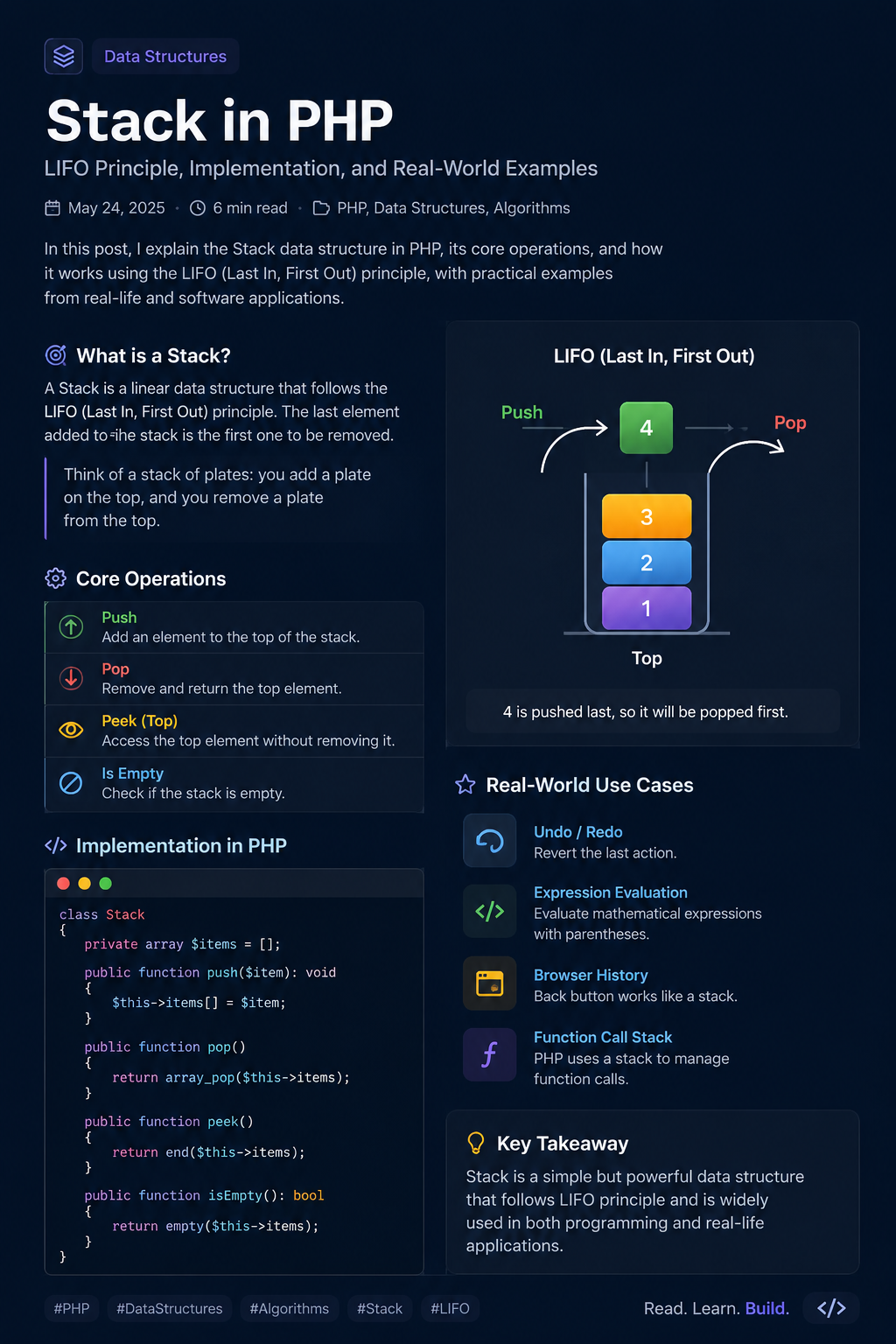
محتوى المقال
Understanding Stack Data Structure in PHPThe Stack is one of the most fundamental data structures in computer science. It follows the LIFO (Last In, First Out) principle, meaning the last element added to the stack is the first one removed.Think of a stack of plates: you place new plates on top, and when you need one, you take the plate from the top.Core Stack OperationsPush - Add an element to the top of the stack.Pop - Remove and return the top element.Peek - View the top element without removing it.IsEmpty - Check whether the stack contains any elements.PHP Implementation Exampleclass Stack{ private array $items = []; public function push(mixed $item): void { $this->items[] = $item; } public function pop(): mixed { return array_pop($this->items); } public function peek(): mixed { return end($this->items); } public function isEmpty(): bool { return empty($this->items); }}Real-World ApplicationsStacks are widely used in software development:Undo and Redo functionalityBrowser navigation historyFunction call management (Call Stack)Expression evaluationDepth-First Search (DFS) algorithmsWhy Every Developer Should Understand StacksAlthough simple, the Stack is a powerful data structure that appears in many real-world systems and programming concepts. Understanding how it works helps developers write more efficient code and better understand the internal behavior of programming languages such as PHP.Key Takeaway: A Stack follows the LIFO principle Last In, First Out and is a foundational building block for many software engineering concepts.