
WordPress remains a practical choice for businesses that need professional websites, flexible content management, and a familiar publishing experience.
For marketing agencies, branding studios, and web design agencies, WordPress projects can create valuable business opportunities.
However, delivering websites requires more than designing attractive pages.
Agencies must also consider responsive development, content management, website performance, security, technical SEO, testing, hosting, and ongoing maintenance.
Managing these technical responsibilities internally can become challenging, particularly for agencies that primarily specialize in marketing, advertising, or creative services.
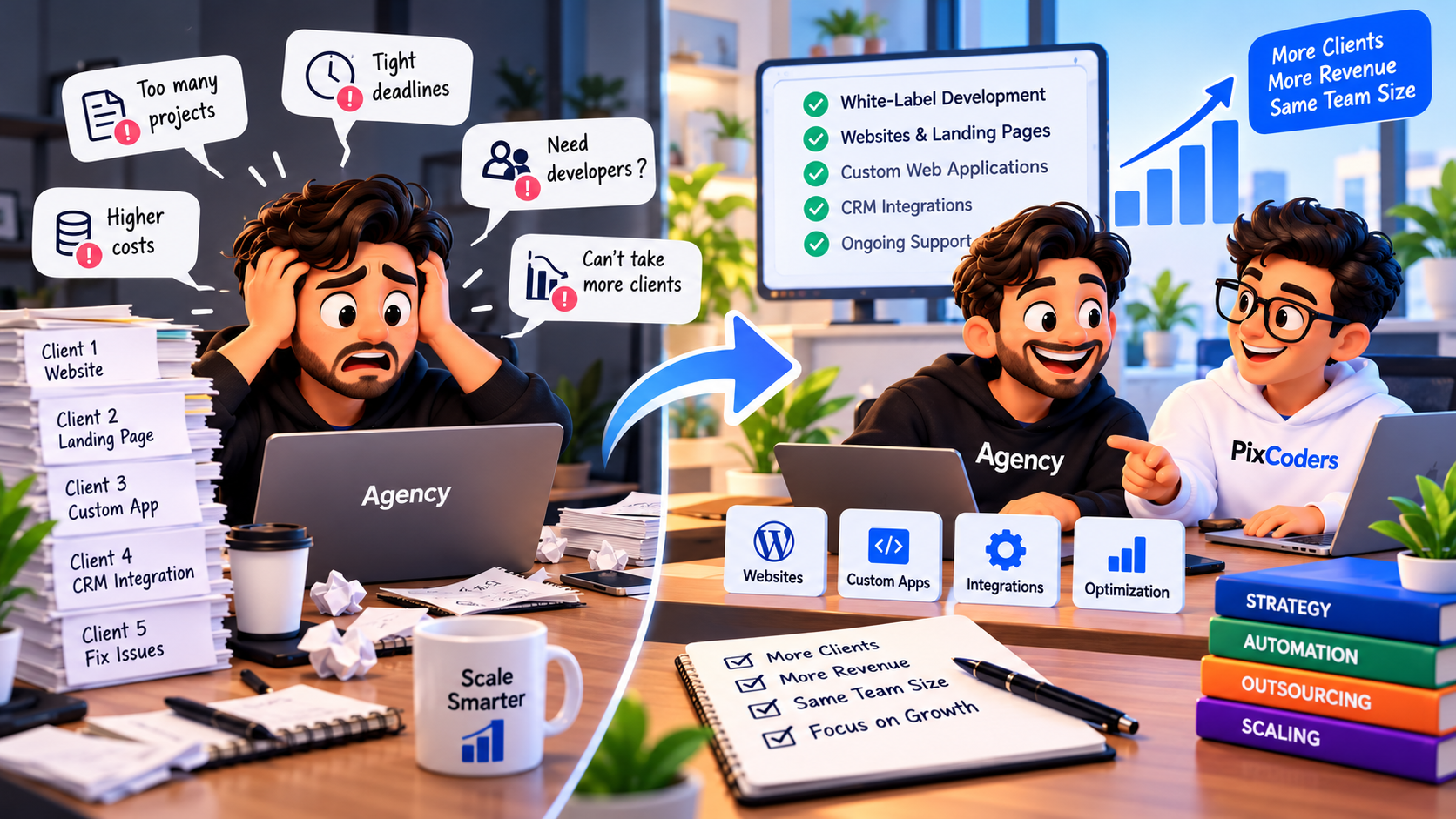
Outsourcing WordPress development allows agencies to deliver professional websites without necessarily hiring permanent developers.
By partnering with an experienced WordPress developer or white-label development provider, an agency can focus on its client relationships while delegating the agreed technical work.
In this guide, we'll explain how to outsource WordPress development, what to look for in a development partner, how pricing works, and how to manage outsourced projects successfully.
1. What Is WordPress Development Outsourcing?
WordPress development outsourcing is the process of hiring an external developer or technical provider to build, customize, maintain, or improve WordPress websites.
Instead of completing every technical task internally, an agency delegates specific development responsibilities.
These may include:
WordPress website development
Custom theme implementation
Website redesigns
Responsive design implementation
WooCommerce development
Plugin configuration
Custom WordPress functionality
API integrations
Technical SEO implementation
Performance optimization
Website maintenance
Hosting and deployment support
The agency can remain responsible for strategy, branding, content, and client communication.
The development provider handles the technical services defined in the agreement.
Example: A Marketing Agency Outsourcing WordPress Development
Imagine a marketing agency specializing in paid advertising and social media management.
One of its clients requests a professional business website containing:
Homepage
About page
Services pages
Blog
Contact form
Mobile-responsive design
Basic technical SEO
The agency has designers and marketers but no dedicated WordPress developer.
Instead of hiring an employee, the agency shares the approved project requirements with an external WordPress development partner.
The developer builds and tests the website.
After reviewing the deliverables, the agency launches the website for its client.
If the arrangement is white-label, the agency can deliver the work under its own brand according to the agreed terms.
2. Why Do Agencies Outsource WordPress Development?
Agencies outsource WordPress development for several business reasons.
Reduce Permanent Hiring Commitments
Hiring developers can involve recruitment, salaries, benefits, equipment, training, and technical management.
Outsourcing provides an alternative when development demand is occasional or unpredictable.
However, agencies should compare total costs because outsourcing is not automatically cheaper than employing developers.
Expand Service Offerings
A creative agency specializing in branding may receive requests for websites.
A paid advertising agency may need campaign landing pages.
A marketing consultancy may want to offer website redesigns.
WordPress outsourcing allows these businesses to provide development services without immediately creating an internal technical department.
Focus on Core Agency Services
Agency teams can spend more time on:
Marketing strategy
Advertising campaigns
Client acquisition
Content creation
Branding
Account management
The development partner handles the agreed technical implementation.
Manage Fluctuating Workloads
An agency may receive one website project in a particular month and several projects the next.
Outsourcing allows agencies to request development services according to project requirements and provider availability.
Access Relevant Technical Experience
WordPress projects sometimes require specialized knowledge of PHP, themes, plugins, performance, security, and integrations.
Working with an experienced development partner can provide access to these capabilities.
3. What WordPress Services Can Agencies Outsource?
WordPress outsourcing covers more than standard business websites.
Business Website Development
Agencies can outsource professional websites for businesses such as:
Consulting companies
Healthcare providers
Real estate businesses
Restaurants
Professional service providers
Construction companies
Common requirements include responsive design, content management, contact forms, and SEO-ready page structures.
Landing Page Development
Marketing agencies frequently need landing pages for advertising campaigns.
A WordPress developer can implement landing pages containing:
Clear calls to action
Contact forms
Campaign-specific content
Responsive layouts
Analytics integrations
Lead tracking configurations
Custom WordPress Themes
Agencies with approved designs may need a developer to turn those designs into functional WordPress templates.
Custom development can be appropriate when a website requires specific layouts or functionality.
WooCommerce Development
WordPress can also support e-commerce websites through WooCommerce.
Depending on the project, development tasks may include:
Product pages
Categories
Shopping carts
Checkout configuration
Shipping settings
Payment integrations
Order management
WordPress API Integrations
Some websites require connections with external services.
Examples include:
CRM platforms
Email marketing applications
Booking systems
Payment gateways
Lead management tools
External business APIs
Website Maintenance
Agencies can outsource ongoing responsibilities such as:
WordPress updates
Plugin updates
Backup checks
Bug fixing
Security monitoring
Performance reviews
Minor website improvements
This can also support recurring maintenance services for agency clients.
4. White-Label WordPress Development vs. Traditional Outsourcing
Although both models involve external development, the branding and communication arrangements may differ.
Traditional Outsourcing
An agency hires an external developer to perform specific technical tasks.
The provider's involvement may be visible to the end client.
White-Label WordPress Development
A developer builds the website on behalf of an agency, which delivers the project under its own brand.
The agency generally manages the client relationship.
The development partner can remain behind the scenes when that is the agreed arrangement.
Why White-Label Development Matters
For agencies, a white-label partnership can support:
Consistent branding
Clear client communication
Confidential project delivery
Additional technical capacity
Long-term development collaboration
However, confidentiality, communication permissions, project ownership, and portfolio rights should be established before work begins.
5. How to Outsource WordPress Development Step by Step
A structured outsourcing process reduces misunderstandings and improves project delivery.
Step 1: Understand the Client's Requirements
Before contacting developers, collect the essential project information.
Ask your client:
What is the main purpose of the website?
Who is the target audience?
How many pages are required?
Is the design already prepared?
Does the client need a blog?
Are multiple languages required?
Will the website need e-commerce functionality?
Are third-party integrations necessary?
When should the website launch?
A clear understanding of business requirements helps establish the appropriate technical scope.
Step 2: Prepare a Detailed Project Brief
A professional development brief should include:
Project Overview
Describe the business, target audience, and website objectives.
Pages and Features
List the required pages, forms, interactive elements, and functionality.
Design References
Provide approved Figma designs, brand guidelines, or visual references.
Content
Clarify whether text, images, logos, and translations are available.
Technical Requirements
Specify integrations, content management needs, hosting constraints, and relevant technical requirements.
Timeline
Include the target launch date and important review milestones.
Budget
Provide a realistic budget range where appropriate.
The more complete the brief, the easier it becomes to receive a useful development estimate.
Step 3: Find a Reliable WordPress Development Partner
Evaluate potential developers based on relevant experience rather than price alone.
Review:
Previous WordPress projects
Responsive implementation quality
Technical skills
Communication practices
Project delivery process
Testing procedures
Maintenance capabilities
Confidentiality arrangements
Ask whether the developer has experience working with marketing agencies or implementing designs supplied by creative teams.
Step 4: Agree on Pricing and Deliverables
Before beginning development, confirm:
Total project price
Included functionality
Number or scope of revisions
Payment milestones
Estimated delivery timeline
Testing responsibilities
Hosting and deployment requirements
Source-code handover
Post-launch support
Any exclusions should be clearly documented.
Step 5: Begin WordPress Development
After approving the scope, the development partner begins implementation.
A typical development process may include:
WordPress environment setup
Theme or template development
Responsive page implementation
Content management configuration
Plugin and integration setup
Technical SEO foundations
Functional testing
Agency review
The process varies depending on the project.
Step 6: Review the Website
Before presenting the completed website to the client, verify that it meets the approved requirements.
Review layouts, forms, navigation, integrations, and content.
Request corrections for issues identified during quality assurance.
Step 7: Deploy and Deliver
Once the website is approved, complete the agreed deployment process.
The handover may include:
WordPress administrative access
Hosting access
Source files or repository access
Plugin and license information
Backup information
Website documentation
Maintenance instructions
The exact handover requirements should be established in the project agreement.
6. How Much Does Outsourcing WordPress Development Cost?
There is no universal price for outsourced WordPress development.
The total cost depends on the complexity of the project and the services included.
Main Pricing Factors
Number of Pages
A single landing page usually requires less implementation work than a large multilingual business website.
Design Complexity
Custom interfaces and advanced responsive layouts may increase development requirements.
Custom Functionality
Booking systems, advanced forms, custom plugins, and other features can affect pricing.
E-Commerce Requirements
Product management, checkout, payment gateways, taxes, and shipping configurations introduce additional complexity.
Third-Party Integrations
External APIs and CRM connections may require additional development and testing.
Content and Translation
Copywriting, product entry, and multilingual content may be separate services.
Maintenance
Ongoing support is usually defined through a separate agreement or included in a specific package.
Common WordPress Outsourcing Pricing Models
Pricing Model | Suitable For |
|---|---|
Fixed-price | Clearly defined websites |
Hourly | Small changes and troubleshooting |
Monthly retainer | Recurring maintenance and development |
Custom quotation | Complex functionality and integrations |
For predictable projects, fixed pricing can simplify agency budgeting.
For evolving requirements, hourly or recurring arrangements may provide greater flexibility.
Important: Always compare what is included in quotations rather than evaluating price alone.
7. How Agencies Can Price Outsourced WordPress Projects Profitably
Agencies should consider both development expenses and their own service costs.
For example, an agency may provide strategy, design, content coordination, project management, and client support in addition to technical development.
Example: Hypothetical WordPress Project
Project Component | Cost |
|---|---|
Outsourced WordPress development | $500 |
Design and content coordination | $150 |
Project management and testing | $100 |
Total direct costs | $750 |
Client selling price | $1,200 |
Gross project profit | $450 |
In this hypothetical example, the gross margin is:
($1,200 − $750) ÷ $1,200 × 100 = 37.5%
These amounts are illustrative and should not be interpreted as standard market rates.
Actual profitability depends on overhead, taxes, revisions, payment fees, and other business expenses.
Consider Your Agency's Full Value
Clients are not necessarily paying only for WordPress installation or development hours.
They may also receive:
Strategy
Professional design
Content organization
Conversion-focused page structure
Project coordination
Quality assurance
Launch support
Ongoing guidance
Your pricing should reflect the complete agreed service.
8. WordPress Quality Assurance Checklist
Before delivering an outsourced WordPress website, verify the following areas.
Design and Responsiveness
Pages display correctly on mobile devices.
Typography is consistent.
Images are properly sized.
Navigation works across screen sizes.
Important content remains readable.
Functionality
Contact forms submit correctly.
Confirmation messages work.
Buttons and links function properly.
Required integrations are operational.
Content management features meet requirements.
Performance
Images use appropriate formats and sizes.
Unnecessary scripts are minimized.
Caching is configured appropriately.
Core Web Vitals are reviewed where relevant.
Performance is tested under realistic conditions.
Security
WordPress core and plugins are maintained.
Accounts use appropriate access permissions.
Administrative access is protected.
Backups are configured.
Sensitive credentials are stored securely.
Unused plugins and themes are reviewed.
Technical SEO
Important public pages are crawlable.
Page titles are configured.
Meta descriptions are provided.
Heading structure is logical.
Canonical URLs are appropriate.
XML sitemap is configured.
Robots directives are reviewed.
Internal links work correctly.
Accessibility
Images have useful alternative text.
Forms have understandable labels.
Keyboard navigation works.
Text has appropriate contrast.
Interactive elements have clear states.
A professional WordPress website should be functional, maintainable, and usable—not merely visually attractive.
9. Common WordPress Outsourcing Mistakes to Avoid
Choosing Based Only on Price
A low quotation may exclude important requirements such as testing, deployment, or maintenance.
Compare complete project scopes.
Starting Without a Clear Brief
Undefined requirements can lead to unexpected revisions and delays.
Document the project before implementation.
Using Too Many Unnecessary Plugins
Installing numerous plugins without evaluating their purpose can increase maintenance complexity and potential compatibility risks.
Use appropriate, well-maintained solutions.
Ignoring Website Security
WordPress websites require sensible security practices, updates, backups, and access controls.
Skipping Mobile Testing
A website may look excellent on a desktop while providing a poor mobile experience.
Forgetting Source-Code Ownership
Agree on ownership, licensing, repositories, and handover requirements.
Promising Unrealistic Deadlines
Delivery timelines depend on project complexity, available content, integrations, and feedback cycles.
Confirm feasibility before committing to clients.
Ignoring Post-Launch Maintenance
Websites may require updates and technical support after delivery.
Clarify responsibilities in advance.
10. How to Manage Multiple Outsourced WordPress Projects
Agencies working with multiple clients should establish a consistent development workflow.
Use Standardized Project Briefs
Create a reusable document for collecting website requirements.
Track Projects Through Milestones
Common stages include:
Requirements
Design approval
Development
Internal testing
Client review
Deployment
Handover
Centralize Communication
Keep project decisions and feedback organized in an agreed communication channel or project management tool.
Define Revision Procedures
Specify how change requests are submitted, reviewed, and approved.
Maintain a Delivery Checklist
Use consistent testing and handover procedures across projects.
Review Development Capacity
Confirm the provider's availability before accepting overlapping deadlines.
A structured approach helps agencies maintain consistent delivery even when working with external developers.
11. Can Agencies Offer WordPress Maintenance as a Recurring Service?
Yes.
WordPress maintenance can provide an opportunity for recurring client relationships.
Depending on the service agreement, maintenance packages may include:
WordPress core updates
Plugin and theme updates
Backup monitoring
Website health checks
Security reviews
Minor content changes
Bug fixing
Performance checks
Agencies can handle client communication while outsourcing the agreed technical maintenance.
However, service packages should clearly define what is included, response expectations, and exclusions.
A maintenance agreement should not promise unlimited development unless the provider can actually support that commitment.
12. How PixCoders Supports Agencies With WordPress Development
At PixCoders, we provide white-label development support for marketing agencies, digital agencies, branding studios, and web design businesses.
We help agencies deliver professional websites while maintaining their client relationships and brand identity.
Our WordPress Development Services
Business Websites
Professional WordPress websites designed around business requirements and responsive layouts.
Landing Pages
Custom landing pages for advertising campaigns, lead generation, and marketing initiatives.
WordPress Customization
Theme modifications, custom functionality, and content management improvements.
WooCommerce Development
Online store functionality and e-commerce configuration based on project requirements.
CRM and API Integrations
Connecting WordPress forms and websites with supported external applications.
Technical SEO and Performance
Implementation of relevant technical SEO foundations and website performance improvements.
Deployment and Maintenance
Technical assistance with website launches, updates, and ongoing support according to the agreed scope.
Our White-Label Workflow
1. Share Your Project Brief
Provide the website requirements, design references, required functionality, and expected launch date.
2. Scope and Development
We review the technical requirements, agree on deliverables, and implement the project.
3. Quality Assurance and Handoff
We test the agreed functionality and provide the appropriate project handover.
We can work behind the scenes while your agency remains the primary point of contact for its clients.
Our goal is to provide dependable technical implementation and clear communication throughout the development process.
Explore our white-label development services:
https://pixcoders.dev/en/services/white-label-web-development
View our development pricing:
https://pixcoders.dev/en/pricing
13. Frequently Asked Questions
Can marketing agencies outsource WordPress development?
Yes. Marketing agencies can collaborate with external WordPress developers to deliver websites while managing strategy, design, client communication, and project coordination.
What is white-label WordPress development?
White-label WordPress development is an arrangement where an external developer builds a WordPress website on behalf of an agency, which delivers the project under its own brand.
How much does outsourcing WordPress development cost?
Pricing varies according to website complexity, design requirements, functionality, integrations, and support. A detailed project brief helps providers prepare accurate quotations.
Is outsourcing WordPress development cheaper than hiring developers?
It can reduce permanent staffing commitments when development demand is inconsistent. However, the total costs of both models should be compared.
Can I outsource WooCommerce development?
Yes. WooCommerce development can be outsourced to providers with relevant experience in WordPress e-commerce functionality.
Who owns the WordPress website after development?
Ownership depends on the agreement and third-party licensing terms. Agencies should clarify intellectual property rights, access credentials, and handover requirements before starting.
Can WordPress websites integrate with CRM platforms?
Yes. WordPress websites can connect with compatible CRM platforms using supported plugins, APIs, or custom integrations.
Can an agency outsource WordPress maintenance?
Yes. Agencies can offer maintenance services while using external technical providers for agreed updates, monitoring, and support tasks.
How do I find a reliable WordPress development partner?
Review relevant projects, evaluate technical experience, discuss communication and confidentiality requirements, and consider starting with a small project.
Conclusion: Outsource WordPress Development With Confidence
Outsourcing WordPress development can help marketing agencies and creative studios expand their service offerings without immediately building an internal development team.
However, successful outsourcing depends on more than finding a developer.
Agencies should prepare clear project requirements, evaluate relevant expertise, establish transparent agreements, and maintain consistent quality assurance.
A reliable development partnership can help agencies deliver professional websites while focusing on their core business activities.
Whether your agency needs a simple landing page, a business website, an online store, or custom WordPress functionality, a structured outsourcing approach can improve project delivery.
Looking for a White-Label WordPress Development Partner?
PixCoders helps marketing agencies, digital agencies, and creative studios build professional WordPress websites, landing pages, and custom web solutions under their own brand.
We can support individual projects or discuss ongoing development collaboration based on your agency's needs.
Share your project brief, available designs, and expected timeline to receive a tailored development estimate.
Website: https://pixcoders.dev
Services: https://pixcoders.dev/en/services/white-label-web-development
Pricing: https://pixcoders.dev/en/pricing
Contact: https://pixcoders.dev/en/contact