
Choosing the right white-label development partner can make a significant difference in how your agency delivers projects, manages client expectations, and grows its service offerings.
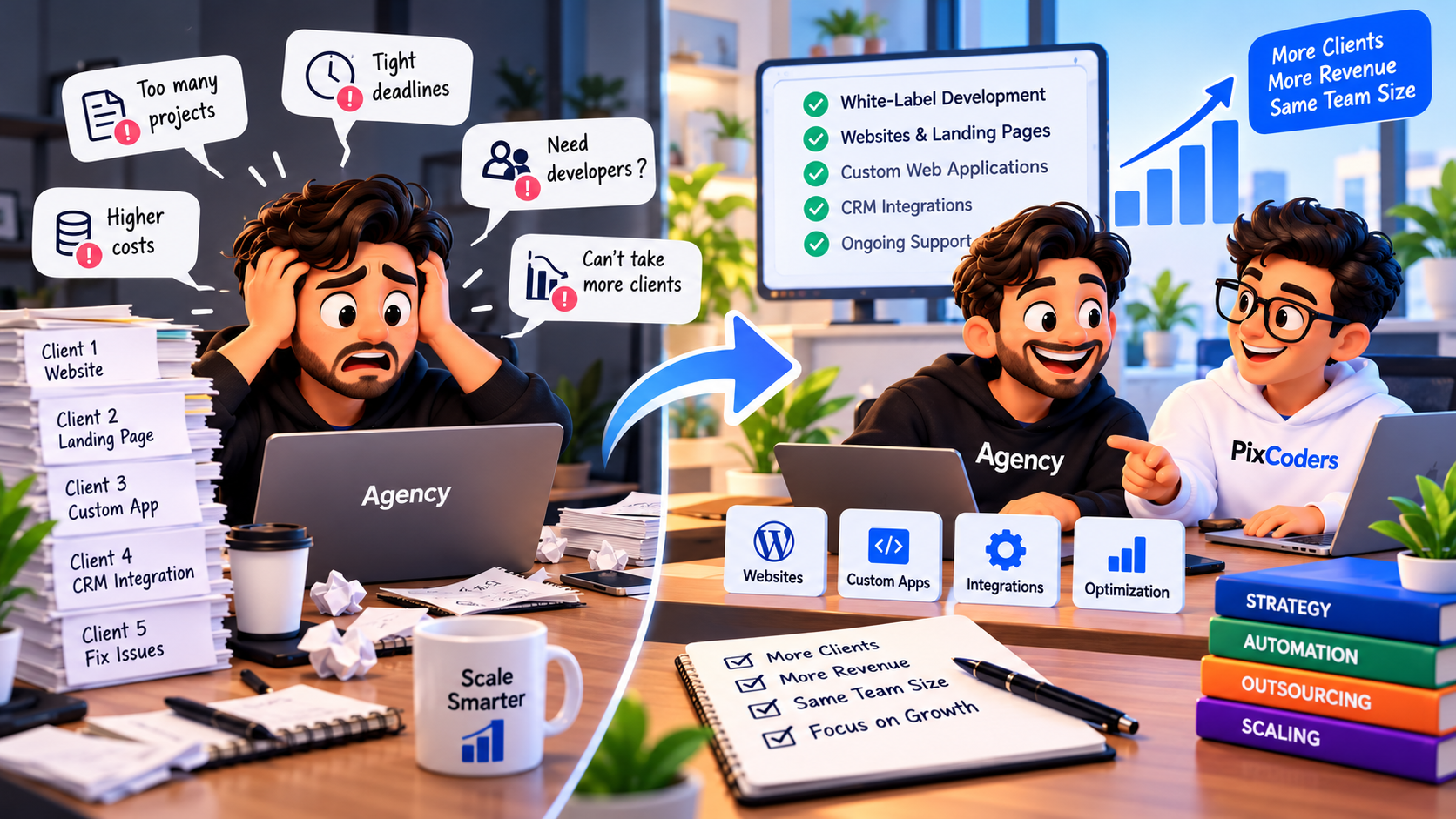
For marketing agencies, branding studios, and digital agencies, client requests often extend beyond their internal technical capabilities.
A client may need a custom WordPress website, a high-converting landing page, a CRM integration, or a web application. Hiring full-time developers for occasional projects is not always practical.
That's where white-label development partnerships become valuable.
However, not every development provider is the right fit for your agency.
Choosing a partner based solely on price can lead to missed deadlines, inconsistent quality, communication problems, and unhappy clients.
This guide explains how to evaluate a white-label development partner, what questions to ask, which warning signs to watch for, and how to build a successful long-term collaboration.
1. What Is a White-Label Development Partner?
A white-label development partner is an external developer or development provider that builds digital products on behalf of another business.
The agency manages the client relationship, while the development partner handles the agreed technical implementation.
The completed project can then be delivered under the agency's own brand.
For example, imagine a marketing agency specializing in paid advertising.
One of its clients requests a custom website with lead capture forms, CRM integration, and conversion tracking.
Instead of recruiting a development team, the agency collaborates with a white-label web development partner.
The partner builds and tests the website, while the agency continues managing client communication, strategy, and delivery.
This model allows agencies to expand their technical capabilities without necessarily expanding their internal teams.
The key to success is finding a partner who understands both technical development and agency workflows.
2. Why Choosing the Right Development Partner Matters
Your development partner directly influences the quality of the services you deliver to clients.
Even when the partner operates behind the scenes, your agency remains responsible for the final result.
A strong partnership can help your agency:
Deliver professional websites and applications.
Accept projects requiring additional technical expertise.
Handle fluctuating development workloads.
Reduce the need for permanent recruitment.
Maintain consistent project delivery standards.
Focus on marketing, branding, and client relationships.
Build recurring client relationships through reliable delivery.
An unsuitable partnership can create the opposite outcome.
Projects may require expensive revisions, deadlines may become unpredictable, and technical issues can damage your agency's reputation.
That's why selecting a development partner should be treated as a business decision, not simply a purchasing decision.
3. Evaluate Technical Expertise and Specialization
Technical experience is one of the first factors to evaluate when selecting a white-label development provider.
Different projects require different technologies, development approaches, and levels of expertise.
For example, a simple business website may be developed using WordPress, while a custom dashboard may require a more specialized application architecture.
A capable development partner should understand which technologies are appropriate for each project.
Important Technical Capabilities
Depending on your agency's needs, look for experience with:
Website Development
WordPress development
Responsive business websites
Custom website functionality
Content management systems
E-commerce development
Frontend Development
React.js
Next.js
JavaScript
Tailwind CSS
Responsive interface implementation
Backend Development
PHP and Laravel
REST API development
Database architecture
User authentication and authorization
Third-party integrations
Business Integrations
CRM integrations
Lead capture systems
Payment integrations
Workflow automation
API connections
Technical Quality
Website performance
Security best practices
Technical SEO foundations
Accessibility considerations
Maintainable code
A good partner should also be comfortable explaining why a particular technology is suitable for your client's requirements.
Pro Tip: Avoid choosing a development partner simply because they list dozens of programming languages. Relevant project experience and demonstrated delivery quality are more valuable than a long technology list.
4. Review Their Portfolio and Previous Projects
A portfolio provides practical evidence of what a development partner can deliver.
Before starting a collaboration, review completed projects that resemble the services your agency intends to offer.
When evaluating a portfolio, consider the following questions:
Are the websites responsive across mobile, tablet, and desktop?
Do the projects demonstrate professional design implementation?
Are navigation, forms, and interactive features working correctly?
Does the provider have experience with complex functionality?
Are websites reasonably fast and accessible?
Does the partner have experience with your preferred technologies?
Look Beyond Visual Design
An attractive website does not automatically mean it has been developed correctly.
For example, a landing page might look excellent but contain broken forms, unreliable tracking, or poor mobile usability.
Similarly, a dashboard may look polished while lacking proper access controls or reliable data handling.
Ask about the developer's responsibilities in showcased projects and how functionality was tested.
You can also request a technical walkthrough or relevant code samples when appropriate and permitted by confidentiality agreements.
Remember: A smaller portfolio containing relevant, well-executed projects can be more useful than a large collection of unrelated examples.
5. Prioritize Communication and Transparency
Communication is one of the most important elements of successful white-label development.
When technical work is outsourced, misunderstandings can quickly become expensive.
A reliable development partner should communicate clearly about:
Project requirements
Technical limitations
Estimated timelines
Development progress
Potential risks
Required client assets
Changes in project scope
Testing and delivery
Establish a Communication Process
Before beginning a project, agree on:
The primary communication channel.
How often progress updates will be shared.
Who approves technical decisions.
How feedback and revision requests are handled.
How urgent problems are escalated.
For agencies managing several clients simultaneously, predictable communication is especially valuable.
A development partner should also feel comfortable identifying potential problems early.
For example, if an integration requires additional documentation or access, the partner should raise that requirement before it affects delivery.
A trustworthy partner does not simply promise that everything is possible. They explain what is feasible, what requires further investigation, and what may affect the project timeline.
6. Verify Confidentiality and White-Label Agreements
Confidentiality is essential when collaborating with external development providers.
Your agency may share sensitive information, including client requirements, design files, credentials, and business processes.
Before starting, establish clear rules regarding confidentiality and client relationships.
Important Questions to Ask
Will the development partner communicate directly with our clients?
Can the partner publicly mention completed projects?
Who owns the source code after delivery?
How are client credentials and sensitive information handled?
Can the partner display the project in their portfolio?
Will the partner sign a confidentiality or non-disclosure agreement?
In many white-label arrangements, the development provider communicates only with the agency.
However, some agencies prefer their technical partner to participate in meetings when necessary.
Both approaches can work, provided expectations are agreed upon in advance.
Protect Client Relationships
Your agency should clearly define who is responsible for client communication, approvals, and project delivery.
If confidentiality or non-solicitation commitments are important, document those requirements in the partnership agreement.
Also clarify intellectual property ownership, third-party licenses, and source-code transfer conditions.
These details should be settled before development begins.
7. Evaluate Development Quality and Testing Procedures
Quality assurance should be part of the development process, not something added at the last minute.
Before selecting a white-label partner, ask how projects are tested.
A professional quality assurance process may include:
Functional Testing
Verify that buttons, forms, navigation, authentication, and other features work according to the approved requirements.
Responsive Testing
Check website layouts across common screen sizes, including smartphones, tablets, and desktop computers.
Browser Compatibility
Test important functionality in major supported browsers.
Performance Testing
Review page loading performance, unnecessary assets, image optimization, and other relevant performance factors.
Security Testing
Validate input handling, access permissions, authentication workflows, and other security controls relevant to the project.
Integration Testing
Confirm that external systems, including CRMs, APIs, and payment services, exchange data correctly.
SEO Readiness
For public-facing websites, verify essential technical elements such as:
Crawlable public pages
Correct heading structure
Descriptive page titles
Meta descriptions
Canonical URLs
Sitemap configuration
Appropriate robots directives
Structured data where relevant
No development provider can guarantee specific search rankings or perfect performance scores for every website.
However, a competent partner should understand the technical foundations required for reliable, search-friendly websites.
8. Understand Pricing and Project Scope
Pricing is important, but the cheapest development quote is not always the most economical option.
An inexpensive project can become costly when requirements are misunderstood or important features are excluded.
Before accepting a quotation, request a clear breakdown of the deliverables.
A Professional Project Estimate Should Clarify:
Included pages and functionality
Development technologies
Third-party integrations
Design implementation requirements
Content responsibilities
Expected delivery milestones
Number or scope of revisions
Testing responsibilities
Deployment requirements
Source-code handover
Post-launch support
Payment terms
For example, two developers may quote different prices for a WordPress website.
One quote may include only the website implementation, while another may include technical SEO configuration, deployment, testing, and maintenance.
Without comparing the actual scope, the prices are not directly comparable.
Think About Your Agency's Profitability
Your development costs must leave enough room for account management, design, revisions, client support, and your agency's desired profit margin.
A sustainable white-label partnership should benefit both businesses.
Best Practice: Agree on a written scope of work before development begins, and define how additional requests will be estimated and approved.
9. Check Maintenance and Long-Term Support
Launching a website is often only the beginning.
After deployment, clients may request content changes, feature improvements, security updates, or additional integrations.
Your agency needs to understand whether its development partner can provide ongoing technical support.
Questions worth asking include:
Is there a defined bug-fix period?
Are security updates included?
Can the partner provide monthly maintenance?
Who handles hosting and deployment issues?
How are new features estimated?
What happens if a third-party integration changes?
How quickly are critical issues acknowledged?
Support arrangements should be documented rather than assumed.
For example, a bug caused by the original implementation may be handled differently from a feature request introduced after delivery.
A clear support agreement helps both businesses avoid misunderstandings.
10. Start With a Small Trial Project
One of the most effective ways to evaluate a new white-label development partner is to begin with a limited, paid project.
Rather than immediately outsourcing a large application, consider testing the collaboration with:
A landing page
A small WordPress website
A website redesign
A CRM form integration
A dashboard component
A clearly defined technical improvement
A trial project allows you to evaluate the actual working relationship.
What Should You Measure?
Communication: Does the partner provide useful updates and respond clearly to feedback?
Technical Quality: Does the delivered functionality meet the agreed requirements?
Reliability: Are milestones respected, or are delays communicated early?
Problem-Solving: Does the partner identify and address technical challenges effectively?
Documentation: Are the deliverables and handover instructions understandable?
Professionalism: Does the partner respect your processes, confidentiality requirements, and client relationships?
A successful small project does not guarantee future performance, but it provides stronger evidence than sales promises alone.
11. Common Red Flags When Choosing a Development Partner
Some warning signs deserve attention before committing to a long-term partnership.
Unrealistic Delivery Promises
Be cautious when a developer guarantees extremely short deadlines without reviewing the requirements.
Reliable estimates depend on project complexity, available assets, and integration requirements.
Vague Pricing
A quotation without clearly defined deliverables can lead to misunderstandings and additional costs.
Lack of Relevant Work
A provider unable to demonstrate relevant experience may not be suitable for a technically complex project.
Poor Communication
Repeatedly unclear responses, unexplained delays, or reluctance to discuss potential risks can make collaboration difficult.
No Testing Process
A development partner who treats testing as optional may expose your agency to avoidable post-launch problems.
Unclear Ownership Terms
Source-code rights, licensing, hosting access, and project handover should be established before the work starts.
Unwillingness to Document Agreements
Professional partnerships benefit from clear written expectations regarding scope, confidentiality, payment, and responsibilities.
Not every warning sign automatically disqualifies a provider, but unresolved concerns should be addressed before proceeding.
12. White-Label Development Partner Evaluation Checklist
Use this checklist when comparing potential development partners.
Evaluation Criteria | What to Verify |
|---|---|
Technical expertise | Experience with the required technologies |
Relevant portfolio | Similar completed projects |
Communication | Clear updates and defined channels |
Confidentiality | Agreement on branding and client contact |
Project management | Milestones, responsibilities, and approvals |
Code quality | Maintainability and technical standards |
Quality assurance | Documented testing process |
Pricing transparency | Clear scope and payment terms |
Project ownership | Defined code and asset handover |
Ongoing support | Maintenance and bug-fix arrangements |
You can score each category from 1 to 5 to compare potential partners more consistently.
However, certain requirements—such as confidentiality, adequate security practices, and relevant technical capability—should be treated as essential rather than optional.
13. Questions to Ask Before Hiring a White-Label Developer
Before selecting your development partner, consider asking these ten questions:
Have you completed similar projects for marketing or creative agencies?
Which technologies do you recommend for our typical client projects?
Can you share relevant portfolio examples?
How do you estimate timelines and development costs?
How do you manage additional requirements or scope changes?
What testing procedures do you follow before delivery?
Can you work confidentially under our agency's brand?
Who owns the source code and other deliverables?
What support is available after deployment?
Can we begin with a small paid project to evaluate the collaboration?
The answers should help you understand how the provider approaches technical delivery and professional collaboration.
14. Why Agencies Work With PixCoders
At PixCoders, we help marketing agencies, creative studios, and digital agencies deliver websites and custom web applications without needing to build every solution in-house.
Our approach focuses on clear project requirements, practical technical solutions, quality assurance, and professional handover.
We understand that agencies need a development partner who respects their brand identity, client relationships, and delivery processes.
White-Label Development Services
PixCoders supports agencies with:
Websites & Landing Pages
Responsive business websites, marketing landing pages, and custom WordPress development.
Custom Web Applications
Client portals, business dashboards, booking systems, and applications built around specific workflows.
Laravel & Next.js Development
Custom frontend and backend solutions using modern web development technologies.
CRM & API Integrations
Connecting forms, lead management systems, business applications, and third-party services.
SaaS & Internal Platforms
Development support for SaaS MVPs, administrative dashboards, and internal business tools.
Our Collaboration Process
Our typical workflow follows three main stages:
1. Project Brief
Share your project objectives, designs, features, integrations, and expected timeline.
2. Development
We review the scope, agree on the deliverables, and develop the required solution.
3. Quality Assurance & Handoff
We test the agreed functionality and provide the appropriate project handover, which may include source code, documentation, and deployment assistance.
We can work behind the scenes as your white-label development partner while your agency remains responsible for the client relationship.
The exact communication, confidentiality, and handover arrangements are agreed upon for each collaboration.
Explore our services: https://pixcoders.dev/en/services/white-label-web-development
View our portfolio: https://pixcoders.dev/en
15. Frequently Asked Questions
What is a white-label development partner?
A white-label development partner is an external developer or development provider that creates websites, applications, or integrations for an agency to deliver under its own brand.
How do I choose the best white-label web development partner?
Evaluate relevant technical experience, portfolio quality, communication, confidentiality, project management, testing procedures, pricing transparency, and ongoing support. Starting with a small paid project can help validate the partnership.
Can a small marketing agency benefit from white-label development?
Yes. Small agencies can use white-label development to deliver websites, landing pages, and integrations without immediately hiring permanent developers. The financial benefits depend on project volume, pricing, and management costs.
Will a white-label development partner contact my clients?
That depends on the agreement. Many white-label arrangements keep the development provider behind the scenes, with all client communication managed by the agency.
Who owns the source code in a white-label project?
Ownership depends on the contract and any applicable third-party licenses. Agencies should clarify intellectual property rights and source-code handover before work begins.
How much does a white-label development partner cost?
Pricing varies according to technical complexity, project requirements, timelines, integrations, testing, and support. A written project scope is usually required for an accurate estimate.
Can I outsource Laravel, React, or Next.js projects?
Yes. Agencies can outsource projects using these technologies to partners with relevant experience in custom web application development.
Is a white-label development partner better than hiring in-house developers?
Neither option is universally better. White-label development can provide flexible technical capacity, while in-house developers may be more suitable for continuous, predictable development workloads. Some agencies combine both approaches.
Conclusion: Choose a Partner Who Supports Your Agency's Growth
Choosing a white-label development partner requires more than comparing prices and programming languages.
The right partner should understand your technical requirements, communicate professionally, respect confidentiality, and consistently deliver work that meets agreed standards.
Before making a decision, review relevant projects, discuss responsibilities, establish clear agreements, and consider testing the collaboration with a smaller project.
A well-managed white-label partnership can help your agency expand its services, manage development demand, and deliver valuable solutions to clients.
Looking for a Reliable White-Label Development Partner?
PixCoders helps marketing agencies, branding studios, and digital agencies build professional websites, landing pages, custom applications, and integrations under their own brand.
Whether you need help with a single project or additional technical capacity for upcoming client work, we're ready to review your requirements.
Share your project brief, design files, and expected timeline to discuss how PixCoders can support your agency.
Website: https://pixcoders.dev
Contact: https://pixcoders.dev/en/contact
GitHub: https://github.com/zobirofkir