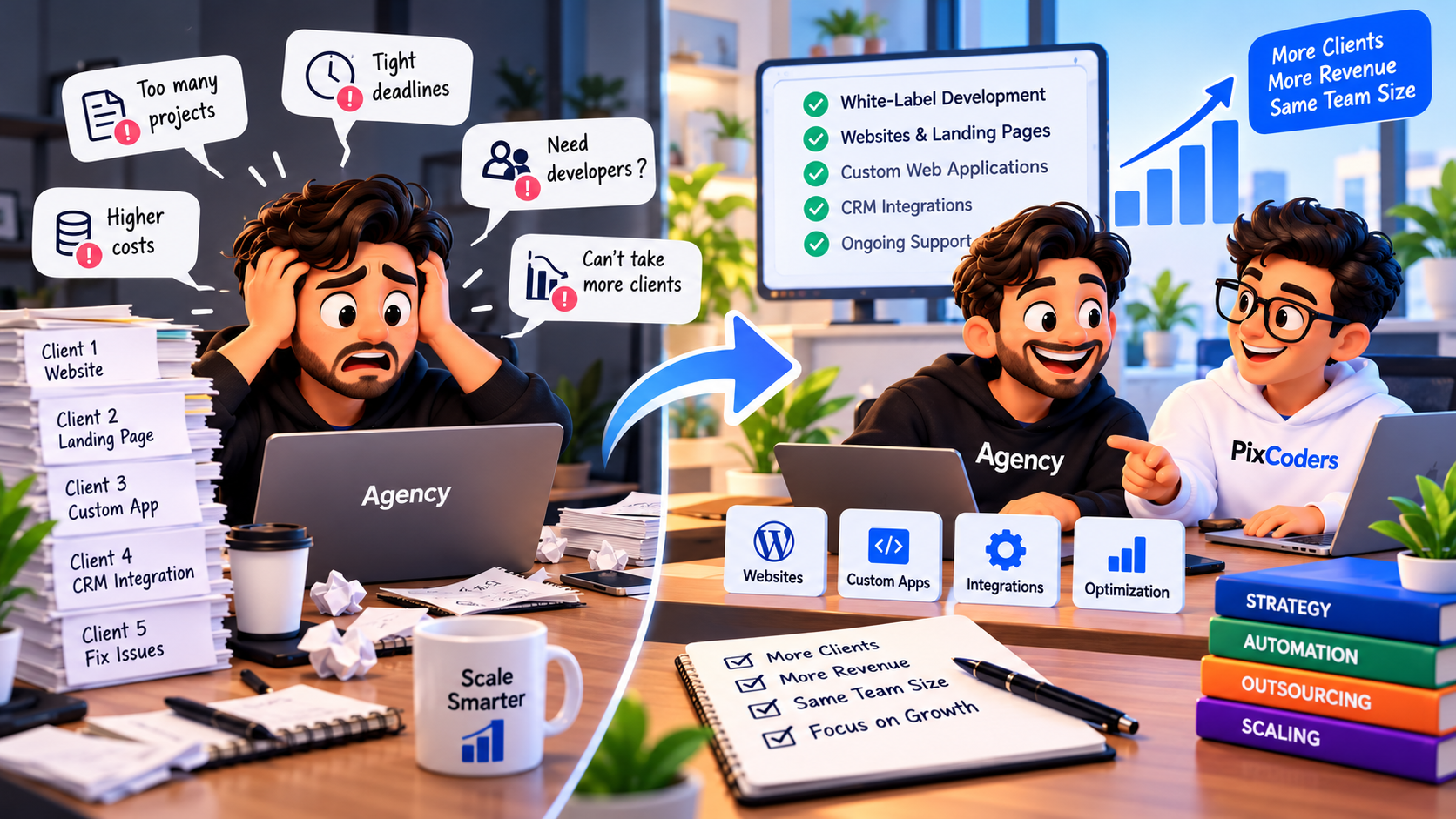
Marketing agencies are expected to deliver more than advertising campaigns. Clients often need websites, landing pages, CRM integrations, and custom web applications to support their marketing activities.
However, building an internal development team requires time, recruitment, technical management, and ongoing costs.
Outsourcing web development allows marketing agencies to expand their services without hiring a full-time development team.
In this guide, we'll explain how marketing agencies can outsource development, choose the right technical partner, and deliver projects under their own brand.
1. What Is Web Development Outsourcing?
Web development outsourcing is the process of hiring an external developer or development partner to build and maintain digital products.
Instead of managing every technical task internally, marketing agencies can delegate development work while focusing on strategy, client relationships, and business growth.
Common outsourced services include:
Business website development
Landing page development
WordPress development
Custom web applications
CRM and API integrations
Website maintenance and technical support
SaaS MVP development
For agencies, outsourcing can provide access to technical expertise without the long-term commitment of hiring additional employees.
2. Why Do Marketing Agencies Outsource Web Development?
Reduce Fixed Operating Costs
Hiring developers involves salaries, recruitment, equipment, onboarding, and ongoing management.
Outsourcing allows agencies to purchase development capacity according to project requirements.
However, outsourcing is not automatically cheaper. Costs depend on project complexity, communication, revisions, and the agreement with the development partner.
Expand Service Offerings
A marketing agency specializing in advertising or branding may receive requests for websites, landing pages, or CRM integrations.
Instead of rejecting these opportunities, the agency can collaborate with a technical partner to deliver the required solution.
Focus on Core Business Activities
Marketing agencies can concentrate on:
Advertising campaigns
Lead generation
Brand strategy
Client acquisition
Account management
Conversion optimization
Meanwhile, the development partner handles the technical implementation.
Scale Development Capacity
Project demand can change from month to month.
Outsourcing makes it possible to access additional development capacity when needed without permanently expanding the internal team.
3. What Is White-Label Web Development?
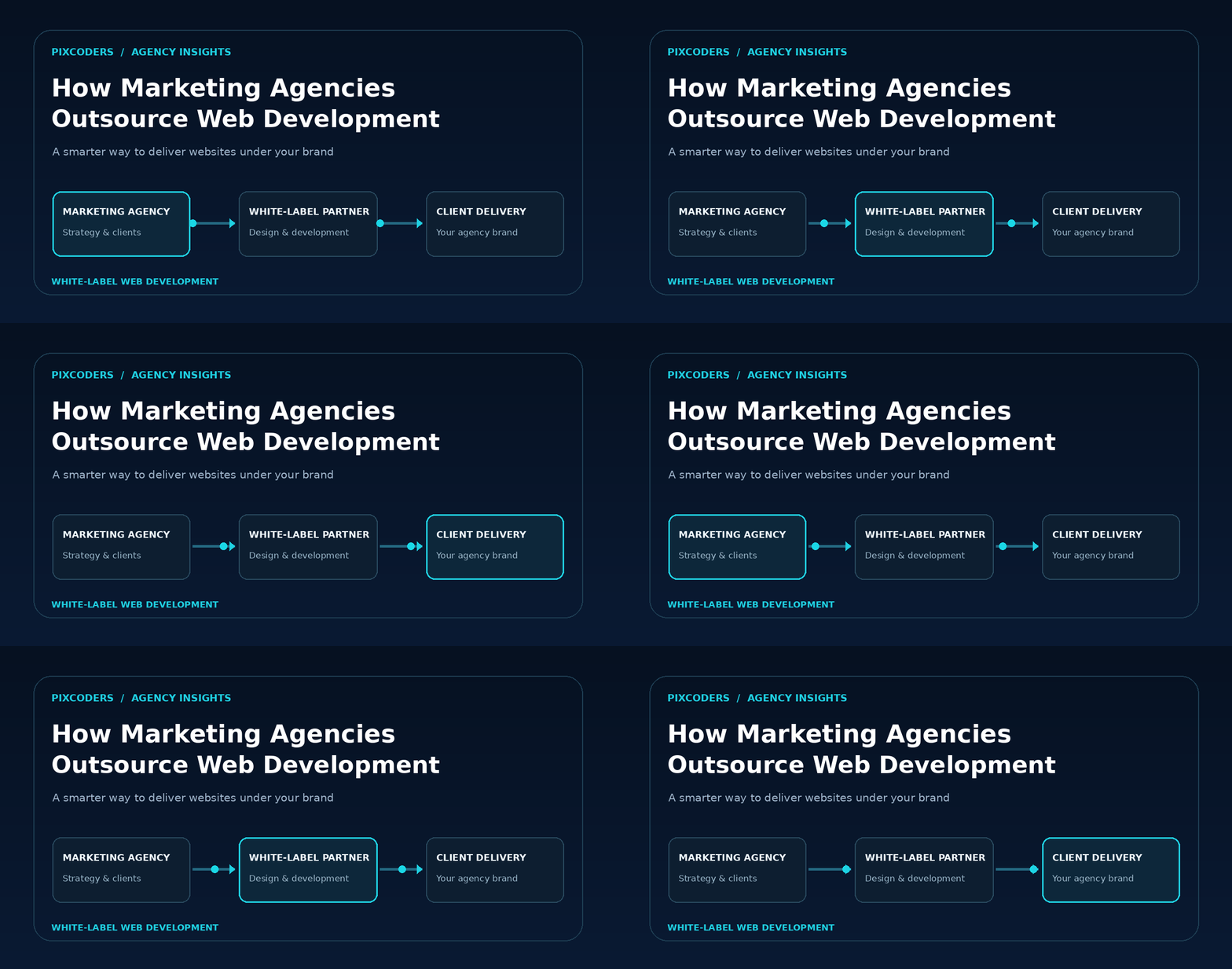
White-label web development is a collaboration model in which a development partner builds websites or applications that an agency delivers under its own brand.
The agency remains responsible for the client relationship, while the technical partner handles the agreed development work.
For example:
A marketing agency signs a contract to create a website for a client.
The agency manages the client, branding, and project requirements.
A white-label development partner builds the website according to the agreed specifications.
The agency then delivers the finished website to its client under the agency's brand.
The client relationship remains with the marketing agency.
Confidentiality, ownership, and communication responsibilities should be clearly defined in the partnership agreement.
4. What Services Can Marketing Agencies Outsource?
Website Development
Agencies can outsource business websites, corporate websites, and custom WordPress projects.
A development partner can handle responsive implementation, CMS configuration, technical integrations, and deployment.
Landing Page Development
Landing pages are essential for many paid advertising campaigns.
Agencies can outsource landing pages designed to support:
Lead generation
Product launches
Appointment bookings
Campaign-specific offers
Conversion tracking
The agency should provide the campaign goals, design requirements, and conversion objectives before development begins.
CRM and API Integrations
Marketing agencies often need to connect websites and forms with CRM platforms and other business tools.
Development partners can help implement:
Lead capture integrations
CRM connections
Custom API integrations
Form submissions
Workflow automation
Lead management dashboards
These integrations can reduce manual work and improve the reliability of lead handling.
Custom Web Applications
Some clients require functionality beyond a standard website.
Examples include customer portals, booking systems, internal dashboards, and custom business applications.
Outsourcing can help agencies deliver these projects without building a specialized internal development department.
5. How to Choose the Right Web Development Outsourcing Partner
Choosing a development partner is one of the most important decisions in the outsourcing process.
Here are several factors to evaluate.
Technical Experience
Review the technologies and types of projects the partner has worked with.
For example, a partner experienced in Laravel, Next.js, React, and WordPress may be suitable for different website and application requirements.
Technology choices should depend on the project rather than the developer's preferences.
Portfolio and Previous Work
Ask for examples of completed projects.
Evaluate:
Responsive design
User experience
Application functionality
Code maintainability
Technical complexity
Performance considerations
A relevant portfolio can provide more useful evidence than a long list of technologies.
Communication
Clear communication reduces misunderstandings and unnecessary revisions.
Before starting, agree on:
Project requirements
Delivery milestones
Feedback process
Communication channels
Revision responsibilities
Confidentiality
If the agency requires white-label delivery, confidentiality is essential.
Clarify whether the development partner can contact the end client, publicly mention the project, or include the work in a portfolio.
These conditions should be agreed upon before development begins.
Maintenance and Support
Website delivery is not always the end of a project.
Discuss bug fixes, maintenance, hosting responsibilities, security updates, and future feature requests.
A reliable agreement should define what is included after delivery.
6. How to Outsource a Web Development Project Step by Step
Step 1: Prepare a Project Brief
Start by documenting the project's requirements.
A useful brief includes:
Project objectives
Target audience
Required pages
Features and integrations
Design references
Content availability
Expected timeline
Budget range
The clearer the brief, the easier it becomes to estimate the project.
Step 2: Define the Scope and Deliverables
Agree on what the development partner will deliver.
For example:
Responsive website
CMS configuration
Contact forms
API integrations
Testing
Deployment
Documentation
Also clarify what is not included.
Step 3: Establish Milestones
Divide the project into manageable stages.
A typical process may include:
Requirements review
Technical planning
Development
Quality assurance
Revisions
Deployment
Handover
Milestones help both parties track progress.
Step 4: Review and Test
Before delivering the project to the end client, verify that the website or application works as expected.
Check responsiveness, forms, navigation, integrations, accessibility, and essential performance requirements.
Step 5: Deliver the Project
After approval, complete the deployment and handover process.
Ensure that the agency receives the agreed access, documentation, and source code.
7. In-House Development vs. Outsourcing
Both approaches have advantages.
In-house development may be appropriate when an agency has consistent development demand, sufficient budget, and the ability to manage a technical team.
Outsourcing may be more suitable when development demand varies, specialized expertise is needed, or the agency wants to expand services without increasing permanent staffing.
Some agencies use a hybrid model, keeping technical leadership internally while outsourcing selected projects.
The right choice depends on project volume, budgets, deadlines, and operational requirements.
8. Common Mistakes to Avoid When Outsourcing Web Development
Choosing Based Only on Price
The lowest quote does not always represent the lowest total project cost.
Poor communication, missing requirements, and repeated revisions can increase expenses.
Starting Without Clear Requirements
Unclear requirements often lead to scope changes and delivery delays.
Prepare a project brief before requesting a final estimate.
Ignoring Ownership and Access
Agree on source-code ownership, hosting access, third-party accounts, and handover responsibilities.
Skipping Quality Assurance
Even when development is outsourced, the agency should review the deliverables before presenting them to the client.
Failing to Define Support Responsibilities
Clarify who will handle bugs, updates, and maintenance after launch.
9. How PixCoders Supports Marketing Agencies
PixCoders provides white-label web development support for marketing agencies, branding agencies, and digital agencies.
Our services include:
White-label website development
Landing pages and funnels
Laravel and Next.js development
Custom web applications
CRM and API integrations
Technical development support
The goal is to help agencies deliver client projects while maintaining their own client relationships and brand identity.
Agencies can share their project requirements, design references, and expected timeline to discuss the appropriate technical approach.
Explore our White-Label Web Development Services:
https://pixcoders.dev/en/services/white-label-web-development
10. Frequently Asked Questions
Can a marketing agency outsource web development without hiring developers?
Yes. Agencies can work with freelance developers or development partners to deliver websites and applications without hiring a full-time development team.
Can outsourced development be delivered under the agency's brand?
Yes. White-label development allows agencies to deliver work under their own brand when the partnership agreement supports that arrangement.
What information should an agency provide before outsourcing?
A project brief should include objectives, required features, design references, integrations, content availability, budget expectations, and the desired timeline.
Who owns the source code?
Ownership depends on the contract. Agencies should clarify intellectual property rights, licensing, and source-code handover before starting development.
Can marketing agencies outsource CRM integrations?
Yes. Development partners can implement CRM integrations, lead capture systems, API connections, and custom automation workflows.
Conclusion
Web development outsourcing can help marketing agencies expand their technical capabilities, manage variable project demand, and deliver additional services to their clients.
Successful outsourcing depends on clear requirements, reliable communication, quality assurance, and well-defined responsibilities.
For agencies that want to offer development services under their own brand, a white-label partnership can be a practical option.
Looking for a technical development partner for your agency?
Explore PixCoders' services or share your project requirements.
Contact PixCoders: